A primary pail with no extra volume fails when foam and fruit solids rise over the rim. A secondary carboy left half empty wastes the wine to oxygen, and a tank sized only by its nameplate fails the personal-use cap if the gallons were never converted.
Wine making equipment for a small batch is a primary fermenter larger than the wine, a secondary vessel close to the wine’s own volume, a way for carbon dioxide to leave, and a way to measure sugar and temperature. NDSU Extension’s list covers about 1 to 6.5 gallons. Speidel’s variable-capacity tank BO, in AISI 304 stainless steel with a floating lid, is printed at 110 to 1,600 litres for must and wine. Those litres still have to be read against 27 CFR 24.75 if the wine is personal production and not for sale.
This page compares vessels. It does not sell equipment, it does not name a winery as the operator of this site, and it does not set a recipe. The beginner sequence and the short shopping list stay on home winemaking for beginners. Fillers and corkers stay on the bottling equipment guide.
Key points:
- Clemson: use a 6-gallon primary fermenter for a 5-gallon batch, and a secondary fermenter nearest the wine volume, such as 5 gallons for 5 gallons.
- NDSU: move to the carboy around specific gravity 1.020 to 1.030, and do not fill above the shoulders.
- Clemson: if the wine will sit in secondary fermentation more than 14 days, choose glass rather than food-grade plastic.
- Speidel BO nameplates: 110, 220, 290, 650, 1,100, and 1,600 litres. The floating lid is what lets the sealed volume follow the liquid.
- 100 US gallons is 379 litres and 200 US gallons is 757 litres, using 3.785 litres per gallon. The 1,100 and 1,600 litre BO tanks sit past the two-adult personal-use ceiling.
Which vessel matches which stage?
The primary fermenter is where the recipe goes in and the first, active fermentation happens. Clemson Extension says primary fermenters are commonly 1 to 7 gallons, that foam and fruit solids rise, and that the vessel’s total volume must be greater than the wine you intend to produce. The printed example is a 6-gallon fermenter for a 5-gallon batch. Food-grade plastic or glass is the material Clemson names. A vessel not made for fermentation can leach into the wine.
The secondary fermenter finishes fermentation and holds the wine while it clears. Clemson’s sizing flips: choose the vessel nearest the exact volume you will transfer, so a 5-gallon fermenter for 5 gallons of wine. The reason given is oxygen. Extra headspace is how a secondary lot spoils. Foam room is a primary problem, not a secondary one, because secondary fermentation is less active.
NDSU Extension uses a food-grade plastic pail of 6 to 8 gallons as the primary fermenter and a glass or plastic carboy of 1 to 6.5 gallons as the secondary. At a specific gravity of about 1.020 to 1.030, the wine moves into the carboy. At that transfer, NDSU says not to fill above the shoulders, so the remaining fermentation has room to expand. An airlock, partly filled with water in the NDSU description, lets carbon dioxide out and keeps air out. Clemson makes the same gas point and adds the failure mode: without a liquid-filled airlock, pressure builds until the fermenter fails.
| Stage | Vessel in the sources | Size rule | Dominant failure mode if the row is ignored | Prevention in the same source |
|---|---|---|---|---|
| Primary | Food-grade pail, 6–8 gallons (NDSU); often 1–7 gallons (Clemson) | Greater volume than the wine. Clemson’s example: 6 gallons of vessel for 5 gallons of wine | Foam and solids overflow; a non-food vessel leaches | Leave the extra gallon; use food-grade plastic or glass |
| Transfer | Carboy, 1–6.5 gallons (NDSU) | Move near specific gravity 1.020–1.030 | Sediment goes with the wine, or the carboy is filled into the neck | Rack off the sediment; stop at the shoulders |
| Secondary hold | Nearest vessel to the wine volume (Clemson) | 5-gallon vessel for 5 gallons of wine | A large air space oxidizes the wine | Match the vessel to the litres you actually transferred |
| Hold past 14 days | Glass carboy rather than food-grade plastic (Clemson) | More than 14 days in secondary | Oxygen through plastic over a long rest | Use glass for the longer maturation |
| Changing fill | Speidel BO variable-capacity tank | Floating lid follows the liquid; 110–1,600 L nameplates | A fixed tank or a half-empty carboy keeps an air headspace | Seat the floating lid at the liquid |
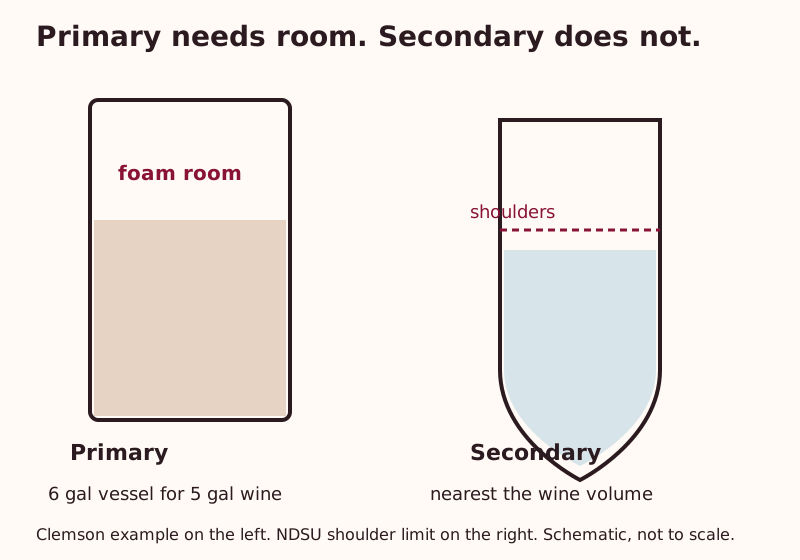
Rule of thumb: If the batch is 5 gallons, the primary vessel is at least 6 gallons and the secondary vessel is 5 gallons, stopped at the shoulders while fermentation is still releasing gas. If the wine will stay in that secondary vessel more than 14 days, the vessel is glass.
Headroom arithmetic for the Clemson example: vessel volume minus wine volume is 6 − 5 = 1 gallon, which is 1/6 of the vessel, or about 17 percent empty at the start. That gallon is the foam allowance in the example, not a universal freeboard for every must. A pulp cap can need the whole extra gallon; a clear juice fermentation needs less rise and still uses a vessel larger than the liquid.
What does a variable-capacity tank change?
A carboy’s fill level is the glass itself. A variable-capacity tank moves the lid. Speidel’s brochure describes the BO tank as a starter size that advanced users also keep for small quantities. Storage, maturation, and fermentation are the listed applications, for wine and for must. Standard equipment on that page is AISI 304 stainless steel on the outside and the inside, an open top with a strengthening rim, a flat bottom, and an external litre scale. The floating lid is listed as an accessory, and the brochure says the lid adapts the volume to the content and locks the tank.
Printed BO capacities, diameters, and heights:
| Capacity | Diameter | Height | Order code in the brochure |
|---|---|---|---|
| 110 L | 440 mm | 765 mm | BO-044-0110 |
| 220 L | 550 mm | 999 mm | BO-055-0220 |
| 290 L | 630 mm | 999 mm | BO-063-0290 |
| 650 L | 820 mm | 1,328 mm | BO-082-0650 |
| 1,100 L | 1,000 mm | 1,493 mm | BO-100-1100 |
| 1,600 L | 1,200 mm | 1,493 mm | BO-120-1600 |
Rim width is about 17 mm up to 290 litres and about 42 mm from 650 litres. The racking outlet is an internal G 3/4 inch BSP thread up to 550 mm diameter, and an external G 1 inch BSP thread from 630 mm diameter. Those threads are the brochure’s fittings, not a claim that every stainless tank uses them.
110 litres is 110 / 3.785 = 29.06 US gallons. One 110 litre tank is larger than a single NDSU carboy: four of the 6.5-gallon carboys are 4 × 6.5 = 26 gallons, and 26 × 3.785 = 98.4 litres. The brochure does not call the tank a stack of carboys; that comparison is only the unit conversion.
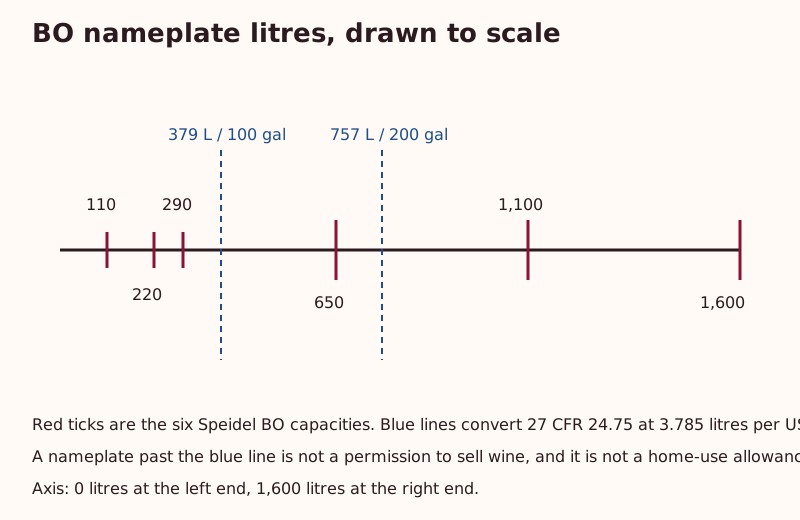
Rule of thumb: If the year’s personal production must stay at or under 200 gallons, the nameplate has to be read in gallons before it is ordered. 650 litres is 650 / 3.785 = 172 gallons, under that ceiling. 1,100 litres is 1,100 / 3.785 = 291 gallons, over it. A tank larger than the legal personal volume cannot be filled to the nameplate inside 27 CFR 24.75. Selling the wine is outside that section entirely. Section 24.75(f) says wine produced under it is not to be sold or offered for sale under any circumstances.
The conversion used above is 1 US gallon = 3.785 litres, so 100 gallons = 378.5 litres, drawn as 379 litres, and 200 gallons = 757 litres. The statute is in gallons. The brochure is in litres. The diagram is only the bridge.
A floating lid removes the “half-empty carboy” failure only when the lid is actually seated on the liquid and the seal holds. The brochure calls the lid an accessory on the BO page. Ordering the shell without the lid leaves an open top, which is the oxygen path Clemson describes for an oversized secondary vessel.
What else is on the bench, and what can wait?
NDSU’s small-batch bench, beyond the two vessels, is a fruit press, a nylon straining bag, a long-handled spoon, a clear siphon hose, a hydrometer, a thermometer, fermentation locks, and a jug for sanitizer. Clemson adds a bung that actually fits the fermenter and the airlock. Bottles on that Clemson page are 750 ml standard, 375 ml demi, and 1.5 L magnum. Those closures and fillers are a later purchase: the bottling equipment guide separates a hand siphon from a multi-spout filler, and how to bottle wine is the fill itself.
Sanitizer is part of the equipment, not a side note. NDSU says everything that touches juice or wine is washed, rinsed, and then sanitized, and names potassium metabisulfite or sodium metabisulfite prepared to the manufacturer’s directions. How that sulfite relates to free SO2, pH, and a label statement is a different measurement, covered in sulfites in wine.
The hidden cost of the wrong vessel is repeated transfers and wasted wine, not a catalog price. Five carboys instead of one lidded tank means five airlocks to watch and five chances to pick up sediment. One tank ordered past the personal-use ceiling means a nameplate the household cannot legally fill under 24.75. Neither problem shows up as a line item on a fitting list.
Temperature equipment is the other unpaid item. NDSU’s fermentation range in this publication is 65 to 80 °F, warmer for red wine and cooler when the aim is to keep fruit aroma. The BO standard-equipment list used here does not include a cooling jacket. A tank without a way to hold that range still needs a room that can, or the fermentation rate is whatever the cellar happens to be. Fermentation timing itself is on wine fermentation explained.
What this list does not buy
- A crusher-destemmer is not in the NDSU fruit-wine list used here. Clemson says fresh fruit can be crushed with a dedicated crusher and press or by hand. This page does not assign a throughput to either one.
- Prices, lead times, and “best tank” rankings are not in these sources.
- State and local law still apply. 27 CFR 24.75(e) says the federal personal-use exemption is not permission to break state or local law, and it does not extend to corporations or associations except as the bonded-premises paragraph provides.
- Bottling-line choices, including a mobile bottling truck, stay on the bottling guide.
Takeaway: Buy the primary vessel one step larger than the wine, the secondary vessel equal to the wine, and a variable-capacity tank only when its litres, converted to gallons, still fit the production you are actually allowed to make.