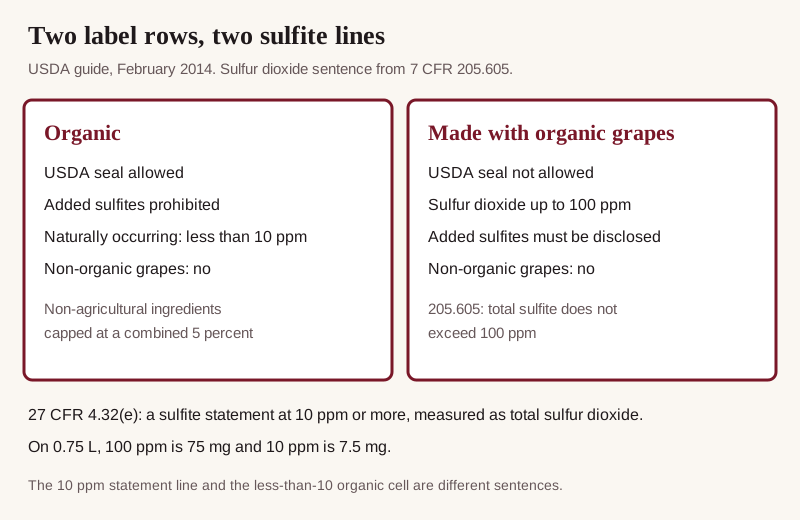
A USDA organic seal on a wine that received sulfur dioxide fails the February 2014 labeling guide. The seal is allowed on the organic category. Sulfur dioxide, in that guide and in 7 CFR 205.605, belongs on wine labeled made with organic grapes, and the total sulfite concentration does not exceed 100 ppm.
This page is the label split. The sulfite measurements page is the free-SO2 and pH arithmetic. The fruit that has to be organic in both wine rows is still chosen in the vineyard, on the harvest record. Other cellar notes are in winemaking.
| Row in the February 2014 USDA guide | What the row prints | Dominant failure mode | Prevention |
|---|---|---|---|
| Organic | USDA seal allowed. Added sulfites prohibited. Naturally occurring sulfites less than 10 ppm | Sulfur dioxide was added, or the seal is used on the other row | Certifier confirms sulfites were not added. A naturally occurring claim needs a lab analysis |
| Made with organic grapes | USDA seal not allowed. Sulfur dioxide only, up to 100 ppm. Added sulfites disclosed. Non-organic grapes not allowed | The seal is printed, or total sulfite exceeds 100 ppm, or a sulfite other than sulfur dioxide is used | Keep the seal off. Stay at or under 100 ppm. Disclose the addition |
| Other wine | Added sulfites allowed. Non-organic grapes allowed. No USDA seal | An organic claim without the oversight the guide requires for the first two rows | Use 27 CFR 4.32(e) for the sulfite statement, and do not borrow the seal |
95 percent, 5 percent, and 70 percent
7 CFR 205.301(b) states that a product sold, labeled, or represented as organic must contain, by weight or fluid volume, excluding water and salt, not less than 95 percent organically produced agricultural products. The remaining ingredients must be organically produced unless they are not commercially available in organic form, or they must be on the National List.
The February 2014 guide states the wine version of that remainder for the organic category: non-agricultural ingredients must be specifically allowed on the National List and must not exceed a combined 5 percent of the total product, excluding salt and water. The arithmetic between those two sentences is:
remainder = 100 - 95 = 5
That 5 is the complement of the 95 percent floor. It is the guide’s combined cap on non-agricultural ingredients for organic wine. It is not a permit to swap in non-organic grapes. The guide’s table says non-organic grapes are not allowed in the organic row, and not allowed in the made-with-organic-grapes row either.
7 CFR 205.301(c) sets a different floor for a product labeled made with organic specified ingredients or food groups: at least 70 percent organically produced ingredients, excluding water and salt. The wine guide’s made-with-organic-grapes row adds the wine constraints on top of that family of claims: organic grapes, no USDA seal, and sulfur dioxide only up to 100 ppm. A 70 percent floor does not, on that row, allow non-organic grapes.
100 ppm in the bottle, and the 10 ppm statement
7 CFR 205.605 allows sulfur dioxide for use only in wine labeled made with organic grapes, provided total sulfite concentration does not exceed 100 ppm. The February 2014 guide says the same ceiling, limits the addition to sulfur dioxide, and says added sulfites must be disclosed. It also says the organic category prohibits added sulfites and allows only naturally occurring sulfites at less than 10 ppm. A statement that the wine contains only naturally occurring sulfites requires a lab analysis.
27 CFR 4.32(e) requires a front, back, strip, or neck label to state “Contains sulfites,” or “Contains (a) sulfiting agent(s),” or the name of the specific agent, where sulfur dioxide or a sulfiting agent is detected at 10 or more parts per million, measured as total sulfur dioxide.
Parts per million here are milligrams per litre. A standard bottle is 0.75 L.
m = C × V
m100 = 100 mg/L × 0.75 L = 75 mg
m10 = 10 mg/L × 0.75 L = 7.5 mg
ratio = 100 / 10 = 10
The 100 ppm ceiling holds ten times the mass of the 10 ppm statement line in the same bottle: 75 mg against 7.5 mg. They are not interchangeable.
Threshold: if total sulfur dioxide is 10 ppm or more, 27 CFR 4.32(e) requires the sulfite statement. If the category is organic, the guide’s naturally occurring cell is less than 10 ppm, so a result of 10.0 ppm meets the statement rule and misses that cell. If the category is made with organic grapes, a total above 100 ppm misses 205.605.
How free sulfur dioxide and pH produce the molecular slice is already calculated on the sulfite page. This page uses total sulfur dioxide, which is the unit in both the statement rule and the 100 ppm ceiling.
Yeast, and what this page does not certify
The February 2014 guide says yeast for organic wine must be certified organic unless the desired strain is not available in organic form. 7 CFR 205.605 says that when yeast is used as food or a fermentation agent in products labeled organic, and the end use is human consumption, the yeast must be organic if it is commercially available. Nonorganic yeast is allowed when organic yeast is not commercially available. Growth on petrochemical substrate and sulfite waste liquor is prohibited. The guide’s phrase is the strain. The regulation’s phrase is commercial availability. A cellar note should record which sentence the certifier applied, and the strain name.
Biodynamic rules and vineyard copper limits are not in the February 2014 guide or in the three CFR sections read for this page. A comparison of organic and biodynamic wine needs those standards open. This page stops at the USDA rows. The harvest checklist still decides when the organic fruit is picked. It does not decide which label row the finished wine can use.
Style names are not these rows. A red wine and a white wine can each be organic, made with organic grapes, or neither. The guide’s split is the seal, the grapes, the yeast, and the sulfite line.
The line to copy before the label is printed
| Field | What to write |
|---|---|
| Category | Organic, made with organic grapes, or neither |
| Seal | Allowed on organic. Not allowed on made with organic grapes |
| Grapes | Organic in both certified rows. Non-organic grapes are a no in the guide’s table |
| Yeast | Strain, and whether the certifier used the strain sentence or the commercial-availability sentence |
| Total SO2 | ppm, then milligrams in the bottle: concentration times 0.75 L for a 750 mL fill |
| Statement | Required at 10 ppm or more under 27 CFR 4.32(e) |
| Organic cell | Naturally occurring, less than 10 ppm, with a lab analysis if that claim is printed |
| Made-with cell | Sulfur dioxide only, at or under 100 ppm, disclosed, no seal |
How this page was checked
The USDA National Organic Program guide “Labeling organic wine,” dated February 2014 on the PDF saved 20 October 2026, supplies the seal row, the less-than-10 ppm organic cell, the 100 ppm sulfur dioxide cell, the ban on non-organic grapes in both certified rows, the 5 percent non-agricultural cap, the yeast sentence, and the lab-analysis note. 7 CFR 205.301 supplies the 95 percent and 70 percent floors. 7 CFR 205.605 supplies the sulfur dioxide annotation and the yeast commercial-availability sentence. 27 CFR 4.32(e) supplies the statement at 10 or more ppm. The 5 percent remainder, the 75 mg, the 7.5 mg, and the ratio 10 are arithmetic on those figures. No wine was analyzed for this page, and the page does not offer wine for sale.