Winery sanitation and cleaning procedures work best when each check answers a separate question: did the cleaning solution reach the surface, did it remove the soil, and did the rinse remove the cleaner? For stainless steel wine tanks, inspect sprayball coverage and tartrate deposits first, then verify the rinse and swab the difficult surfaces before completing sanitation.
A tank is ready for sanitation when its cleaning checks meet the winery’s established procedure: visible residue is removed, cleaner residues pass the specified rinse test, and selected ATP control points meet their location-specific limits. A passing swab applies to the area sampled. Use coverage inspection, chemical checks and ATP results together to decide what needs recleaning.
- Check behind obstructions and around fittings, as well as the open tank wall.
- Remove tartrate before applying sanitizer.
- Use rinse tests for chemical residues and ATP swabs for biological residues.
- Record failed locations, corrective cleaning and repeat results before release.
Why must tartrate come off before sanitation?
Cleaning removes deposits; sanitation reduces the microbial load on the cleaned surface. A coating of tartrate or wine residue interferes with the sanitizer reaching that surface. Applying more sanitizer leaves the underlying cleaning problem unresolved.
The Australian Wine Research Institute’s Cleaning winery floors, tanks and hoses describes tartrate coatings after fermentation and cold stabilization, together with red-wine pigment staining. Denise Gardner’s Penn State Extension article, Making cleaning and sanitation practical for the small commercial winery, also identifies tartrate removal as a prerequisite for effective tank sanitation.
Start by separating the evidence you need:
| Check | Question it answers | Action when it fails |
|---|---|---|
| Visual inspection | Is accessible soil, staining or scale still present? | Reclean the affected surface and inspect again. |
| Spray coverage assessment | Does the cleaning system reach the intended surfaces? | Investigate head placement, obstructions and operating conditions. |
| Chemical-rinse test | Has the relevant cleaning chemical been removed to the procedure’s acceptance criterion? | Continue or correct the prescribed rinse, then resample. |
| ATP surface swab | Does biological residue at this control point meet the established limit? | Reclean and retest the failed location. |
| Sanitation record | Was the specified sanitation treatment completed? | Correct the missed treatment before release. |
This sequence fits between emptying a tank and putting it back into service. For the surrounding cellar operations, browse the winemaking and bottling guides.
Where can a CIP sprayball miss the tank?
A shadow zone is a surface sheltered from the cleaning spray by an internal obstruction. Inspect the tank’s actual geometry: an exposed wall and the underside of an internal fitting can receive very different cleaning action.
Alfa Laval’s PlusClean technical leaflet identifies areas below agitator blades and other tank internals as cleaning shadows. It also distinguishes static spray balls, rotary spray heads and rotary jet heads. Identify the installed device before evaluating its performance; a static ball has no rotation to check.
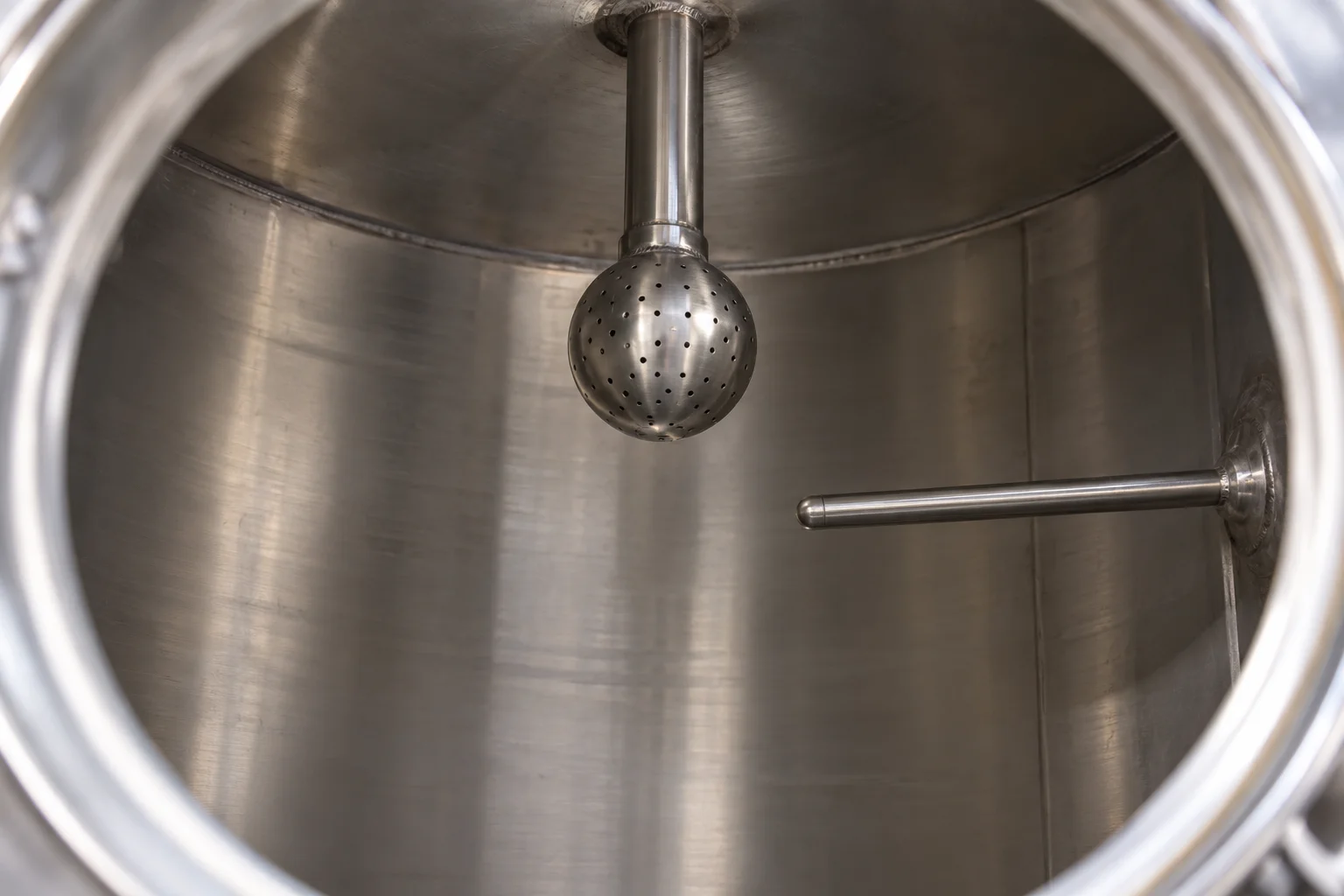
For a wine tank with a thermowell, manway lip or internal pipework, include the surfaces behind those features in the inspection plan. Treat them as locations to investigate: their cleaning performance depends on the head, its position and the installed geometry.
Check the head’s condition and installation against its equipment instructions, then compare the actual flow, pressure and cycle duration with the approved cleaning program. Increasing time alone does not establish coverage of a sheltered surface. Alfa Laval’s Gain a fresh perspective on tank cleaning considers head placement together with flow, time and pressure, and describes riboflavin testing as one option for assessing coverage. Arrange a tank-specific assessment when deposits repeatedly remain in the same place or the internal arrangement changes.
Coverage testing answers where the cleaning action reaches. Soil inspection and cleaning verification still determine whether the cleaning task succeeded.
How should a caustic CIP cycle remove tartrate?
Pre-rinse to remove bulk wine residue, then use the selected cleaning product at the concentration and temperature specified for the tank procedure. Run the spray-head cycle with the required liquid supply and return arrangement, and inspect the result after the equipment is safely stopped and isolated.
AWRI’s spray-head guidance uses a caustic stage for color and tartrate removal, with preparation conditions tied to the product. The practical endpoint is the removal of deposits: a completed timer does not resolve scale still visible on the wall. Where residue remains, identify whether the issue is chemical condition, contact with the surface or an obstructed location before repeating the appropriate cleaning step.
Penn State Extension’s Preharvest Planning and Winery Sanitation describes alkaline cleaners as effective on tartrates and warns that excessive concentration can corrode stainless steel. Keep concentration within the selected product’s instructions; use its safety data sheet for chemical handling and protective equipment.
Drain and rinse between chemical stages as the approved procedure requires. Where that procedure includes citric neutralization, carry it out as a controlled separate step. Prepare chemicals according to their labels, and never mix acid and caustic concentrates.
Which fittings need separate cleaning?
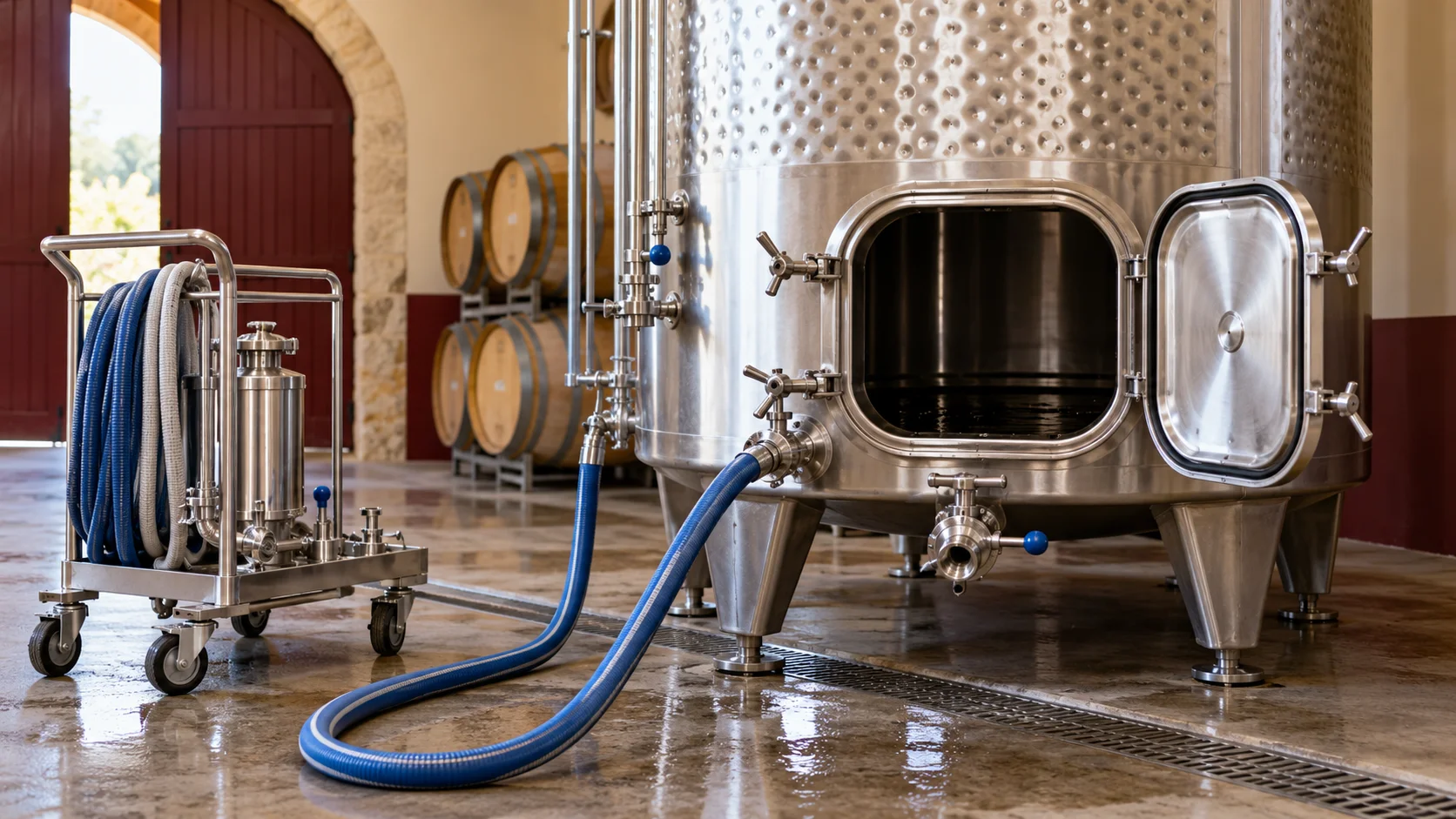
Remove and clean accessible seals and fittings as directed by the equipment procedure. A clean tank shell leaves a separate question about the surfaces inside a valve or beneath a seal.
AWRI recommends removing door and fitting O-rings for hand cleaning and operating sample valves, taps and gauges during cleaning so solution contacts their surfaces. Follow the valve manufacturer’s instructions for the cavities and parts that need disassembly; moving a handle does not demonstrate that every internal recess has been reached.
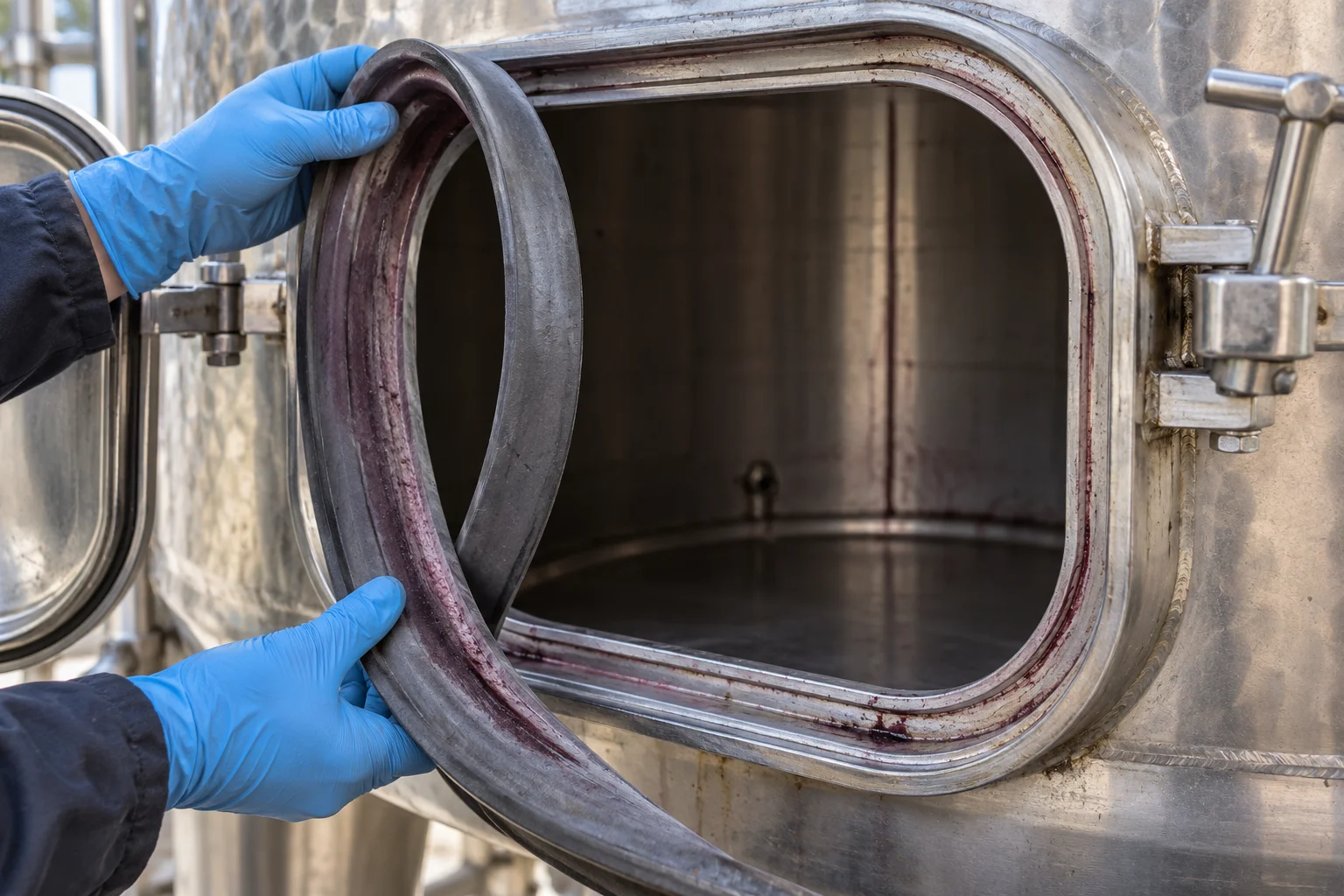
Use a consistent inspection route around the manway seal, outlet assembly, sampling assembly and other removable wine-contact parts. Look for retained residue and damaged sealing surfaces before reassembly. In its bulk-wine transport guidance, the OIV specifically calls for attention to manway seals, outlet valves and washers, including replacement when their condition requires it.
Keep inspection and cleaning outside the vessel wherever the equipment permits. Any task requiring tank entry must follow the facility’s confined-space entry controls. Isolate equipment before opening or dismantling it, and complete reassembly checks before restarting the system.
How do you verify the final cleaning rinse?
Test a rinse sample using the method and acceptance criterion selected for the cleaning chemical. Record the sampling point and result so the next operator can tell which part of the rinse was checked.
The OIV’s Guide to good practices for the transport of wine in bulk, section 6.2.1.2, calls for removal of cleaning-agent residues and includes indicator tests or pH paper among the checks. That guidance concerns transport tanks; it provides a useful example of checking chemical removal separately from visual cleanliness.
For a winery tank, specify the rinse method before the job begins. If the procedure uses pH, record the supply-water reference and the acceptance criterion established for that process. A reading near pH 7 alone cannot demonstrate removal of every cleaning chemical. Use the chemical supplier’s recommended residue test where pH does not adequately address the cleaner being used.
When the rinse result fails, continue or correct the prescribed rinse and take another sample. Keep this result separate from the ATP reading: one measures a chemical property, while the other responds to biological material.
After the cleaning checks, follow the sanitizer’s directions for concentration, contact time, draining and any subsequent rinse. Gardner’s Penn State guidance explicitly ties post-sanitation rinsing to the product instructions. An extra water rinse is not an automatic final step for every sanitizer.
Where should you take ATP swabs on a wine tank?
Choose repeatable control points on the surfaces that are difficult to clean, then use the same sampling technique each time. Useful candidates include the accessible inner outlet lip, a removable valve component, the manway seal area and a safely accessible surface associated with a recurring coverage concern.
Hygiena’s EnSURE Touch Implementation Guide recommends selecting hard-to-clean locations and establishing limits for individual control points. Write the precise location into the plan: “inner lower lip of the tank outlet” is easier to repeat than “tank outlet.” Keep different locations identifiable in the results.
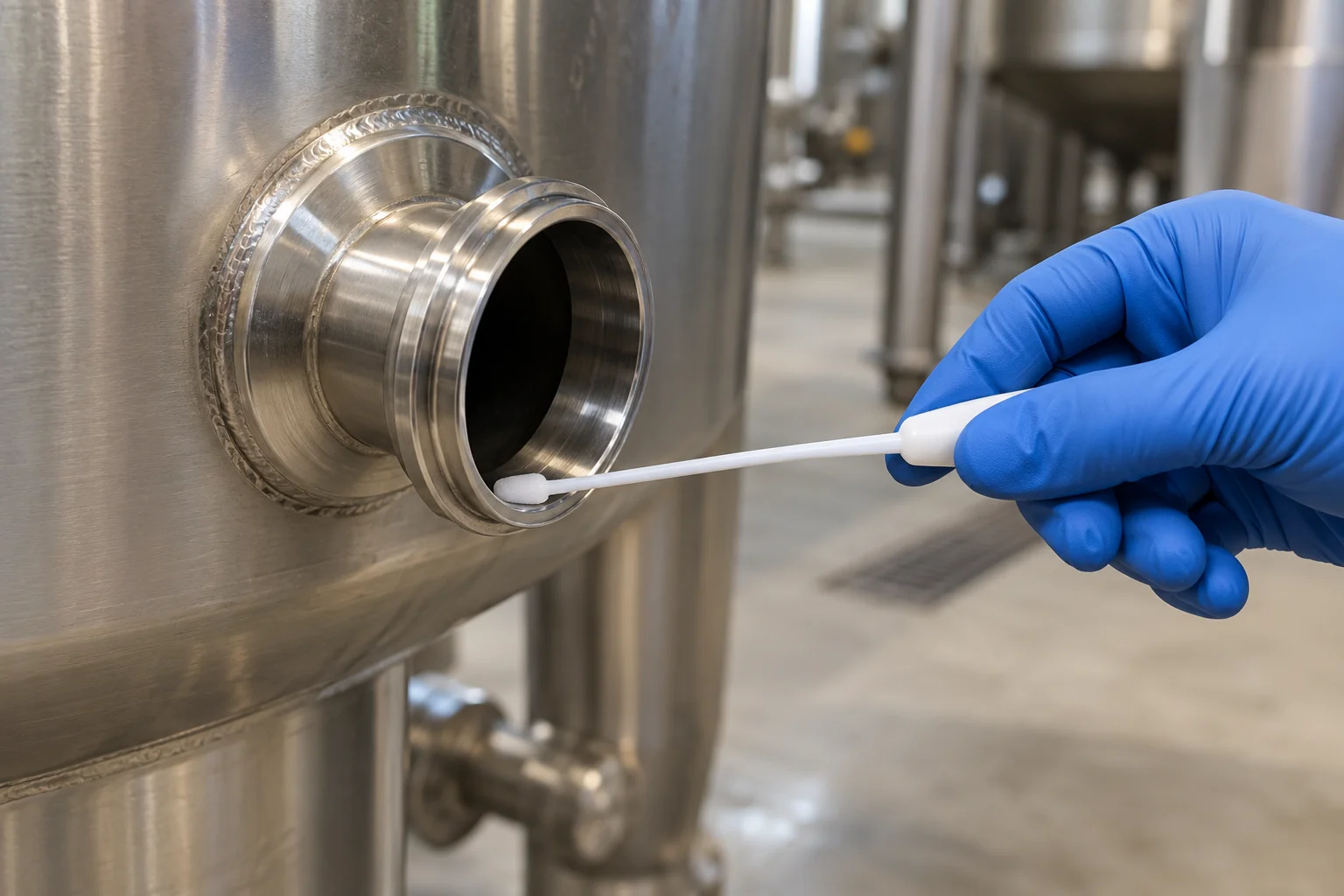
Sample after cleaning, at the defined point in the procedure
Hygiena recommends a clean–test–sanitize sequence where possible. Remove visible soil and complete the relevant cleaning rinse before sampling. If the winery procedure tests after sanitation, follow the ATP system’s chemical-compatibility guidance and the sanitizer’s required contact conditions: chemical interference can change the measured signal.
Use the swab maker’s instructions for storage, preparation, sampling, activation and reading time. Avoid touching the swab tip or shaft. In the EnSURE Touch guide available on 27 October 2026, Hygiena describes a 10 × 10 cm area where practical, sampled in a crisscross pattern while rotating the tip and applying pressure. For irregular parts, it directs the operator to sample as much of the surface as possible. Define that component and sampled area consistently in the winery’s plan.
Interpret the result against the location’s limits
ATP is adenosine triphosphate, a biological molecule measured by a light-producing reaction. The instrument reports relative light units, or RLU. Biological residue can contribute to that signal; the reading does not identify a spoilage organism or count its viable cells.
Use the limits established for the facility, location, instrument and test system. Hygiena’s guide explains that RLU scales differ among systems, so transferring another instrument’s pass number can give a misleading decision.
For a failed location, reclean, complete the required rinse and retest. Follow the facility’s corrective-action rule for caution results. Investigate repeated failures by location: a recurring outlet failure points the inspection toward that assembly, while widespread failures call for checking the overall cleaning cycle. Never average a failed point into passing readings from easier surfaces to clear the tank.
Once the required cleaning checks pass, complete sanitation and the winery’s release procedure. Include microbiological monitoring where that program calls for it; ATP provides a rapid cleaning check rather than an organism-specific result.
What should the tank cleaning record contain?
Keep the record specific enough to reconstruct the job and its corrective work. Use the following fields alongside the winery’s approved procedure:
| Record field | Detail to capture |
|---|---|
| Tank and operator | Tank identifier, date, operator and procedure version |
| Cleaning setup | Installed head, fittings removed and coverage concerns |
| Cleaning cycle | Product and actual concentration, temperature, duration, and relevant head operating conditions |
| Inspection | Tartrate or residue findings, seal and valve condition, and recleaned areas |
| Rinse verification | Sampling point, test method, acceptance criterion and result |
| ATP verification | Defined control point, test system, RLU result, applicable limit and decision |
| Corrective action | Failed location, cleaning repeated and repeat test result |
| Sanitation and release | Treatment completed, required drain/rinse steps, reassembly checks and release sign-off |
The record should make the next action clear: resolve a coverage problem, remove remaining scale, repeat a rinse or reclean a failed swab location. Then complete sanitation on the cleaned equipment before its next use.