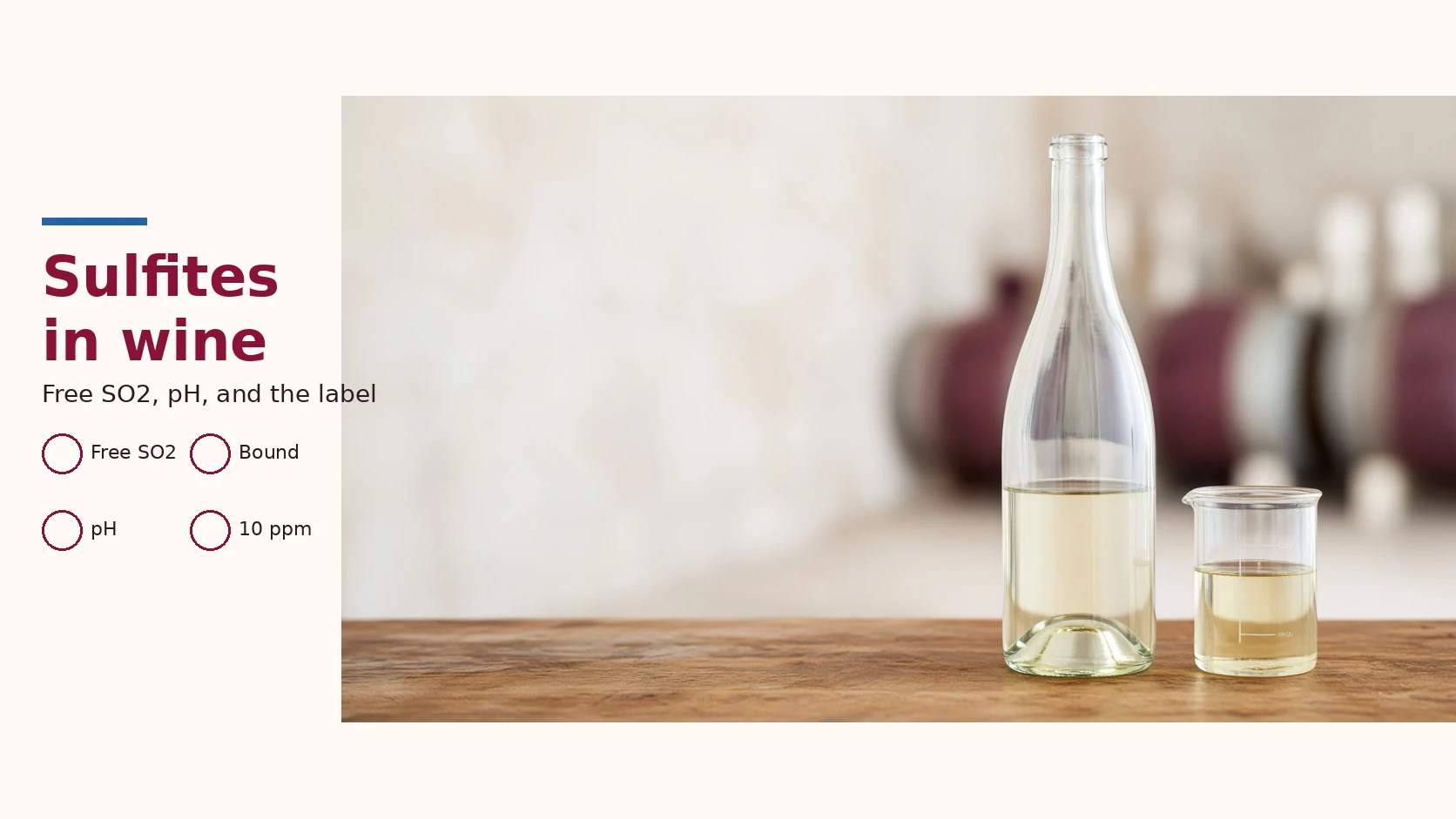
A free-SO2 number copied from the wrong pH fails the molecular target even when the free reading looks familiar. A bottled wine also fails the US label rule once total sulfur dioxide reaches 10 ppm and the sulfite statement is missing.
Sulfites in wine, for this page, means sulfur dioxide and the sulfiting agents measured as total sulfur dioxide. The Australian Wine Research Institute separates that total into free and bound forms and calculates the molecular slice from free SO2 and pH. US rules then use total sulfur dioxide for the “Contains sulfites” statement at 10 ppm, and a 100 ppm ceiling for sulfur dioxide in wine labeled “made with organic grapes.”
This page is a study note on those measurements and label lines. It is not medical advice, it does not diagnose sulfite sensitivity, and it does not say whether anyone should drink wine. It is also not a recipe and not a product of any winery that once used this domain.
Key points:
- Free SO2 is the unreacted portion. Bound SO2 is the portion tied to other wine components. Total SO2 is free plus bound.
- Molecular SO2 = free SO2 / (1 + 10^(pH − 1.8)), with both SO2 values in mg/L. The formula is the water equilibrium at 25 °C and leaves alcohol out.
- AWRI’s general aim is more than 0.8 mg/L molecular SO2 in white wines and more than 0.6 mg/L in reds.
- At 35 mg/L free SO2, that formula gives 0.86 mg/L molecular SO2 at pH 3.40 and 0.35 mg/L at pH 3.80.
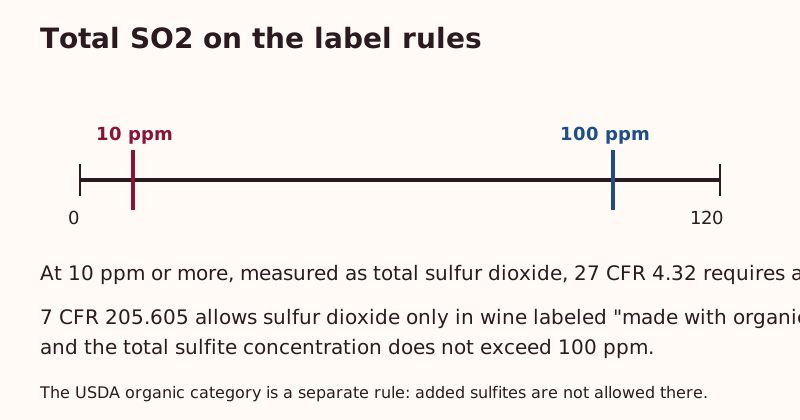
- 27 CFR 4.32 requires a sulfite statement at 10 ppm or more, measured as total sulfur dioxide.
- Added sulfites are prohibited on USDA “organic” wine. Sulfur dioxide is allowed on “made with organic grapes” wine only inside the 100 ppm total-sulfite ceiling.
What are the free, bound, and molecular forms?
Sulfur dioxide exists as a gas. Added to wine, it converts to molecular SO2, bisulfite (HSO3−), and sulfite (SO3 2−). At wine pH the abundant forms are molecular SO2 and bisulfite. AWRI’s January 2017 note says the molecular form is responsible for the antioxidant and antimicrobial effects of SO2 in wine.
Wineries report three measured pools, which are not the same three chemical forms:
| Pool | What it contains | What it is not |
|---|---|---|
| Free SO2 | Unreacted SO2, mostly molecular SO2 plus bisulfite | A single number that already includes pH |
| Bound SO2 | Bisulfite bound to other components, including pigments and phenolics | The antimicrobial target by itself |
| Total SO2 | Free plus bound, described by AWRI as the total amount added | The same thing as molecular SO2 |
A free-SO2 meter reading therefore still needs a pH before anyone can say how much molecular SO2 is present. The fermentation page already covers where sulfur dioxide sits in the crush-to-bottle sequence; this page is the arithmetic and the label line. See how wine fermentation works for the stage timing, and home winemaking steps for the small-batch sequence that uses a sulfite addition before yeast.
How do you calculate molecular SO2 from free SO2 and pH?
AWRI’s calculator uses this formula, cited there to Margalit (1997):
Molecular SO2 = free SO2 / (1 + 10^(pH − 1.8))
Both the molecular result and the free SO2 are in mg/L. The note says the formula comes from the SO2 equilibrium in water at 25 °C, so alcohol is not in it. Temperature and alcohol still change the result in the wine: AWRI says increases in either one increase molecular SO2, and temperature has the greater effect. A colder, lower-alcohol wine holds less molecular SO2 than a warmer, higher-alcohol wine at the same pH and free SO2.
Worked example, using only that formula. Free SO2 is 35 mg/L.
At pH 3.40 the exponent is 3.40 − 1.8 = 1.6. Then 10^1.6 = 39.8107, the denominator is 1 + 39.8107 = 40.8107, and 35 / 40.8107 = 0.858 mg/L, which rounds to 0.86 mg/L.
At pH 3.80 the exponent is 2.0. Then 10^2.0 = 100, the denominator is 101, and 35 / 101 = 0.347 mg/L, which rounds to 0.35 mg/L.
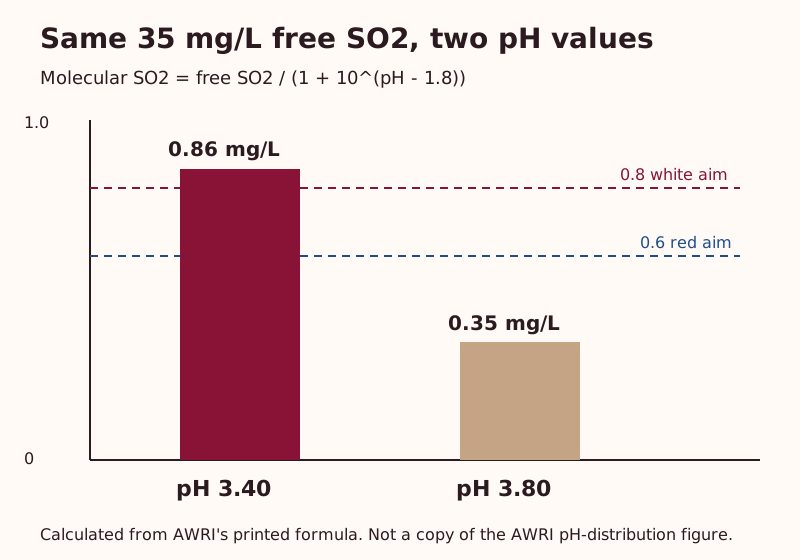
AWRI also states the direction without this particular pair of numbers: for the same free SO2, molecular SO2 at pH 3.5 is twice the amount at pH 3.8 (Delfini and Formica, 2001, as cited in that note).
Rule of thumb: If free SO2 is 35 mg/L and pH is 3.80, molecular SO2 is 0.35 mg/L, which is under both the 0.6 mg/L red aim and the 0.8 mg/L white aim. The free SO2 that reaches 0.8 mg/L is 0.8 × 40.8107 = 32.6 mg/L at pH 3.40, and 0.8 × 101 = 80.8 mg/L at pH 3.80. Copying 35 mg/L from the lower pH into the higher pH fails the white aim.
AWRI is explicit that the aim depends on wine type and on whether the addition is for oxidation or for a particular microorganism. The 0.6 and 0.8 mg/L figures are the general aims in that note, not a dose for every lot. For how the 0.8 mg/L molecular SO2 target is applied across direct-press, cold-macerated, and higher-pH saignée rosés to inhibit grape tyrosinase and block malolactic bacteria, see how rosé wine is made.
Which label line fails if total SO2 is ignored?
27 CFR 4.32(e), read October 19, 2026, requires a statement on a front label, back label, strip label, or neck label when sulfur dioxide or a sulfiting agent is detected at a level of 10 or more parts per million, measured as total sulfur dioxide. The statement is “Contains sulfites,” or “Contains (a) sulfiting agent(s),” or a statement that names the specific sulfiting agent.
The paragraph applies to a certificate of label approval issued on or after January 9, 1987; to wine bottled on or after July 9, 1987, whatever the certificate date; and to wine removed on or after January 9, 1988.
That 10 ppm test is total sulfur dioxide, not molecular SO2 and not free SO2. A wine can sit under the 0.8 mg/L molecular aim and still be at or above 10 ppm total, because bound SO2 counts in the total. The reverse is also true: a very low total is a labeling fact, not proof that the molecular target was met.
What does “organic wine, no sulfites” allow?
The USDA organic regulations and TTB labeling are both in play. The National Organic Program wine-labeling guide splits the claims.
| Label category | Added sulfites | Ceiling in the sources | Dominant failure mode if the row is ignored | What the sources require instead |
|---|---|---|---|---|
| “Organic,” USDA seal allowed | Prohibited. Guide: naturally occurring only, less than 10 ppm | A “naturally occurring sulfites” statement needs a lab analysis | An addition, or a seal on a wine that received sulfur dioxide | Certifier confirmation that sulfites were not added |
| “Made with organic grapes” | Sulfur dioxide only. The guide’s label example says other sulfites, such as potassium metabisulfite, are prohibited | 7 CFR 205.605: total sulfite concentration does not exceed 100 ppm. The guide’s table says sulfur dioxide only up to 100 ppm, and its label example says the certifier verified less than 100 ppm | Potassium metabisulfite, a total over the ceiling, or the USDA seal on this category | Certifier review, the sulfite disclosure, and no USDA organic seal |
| Other wine | The organic table does not forbid sulfites | The 10 ppm TTB statement still applies when total SO2 is at or above that level | A commercial label with no sulfite statement at 10 ppm or more | 27 CFR 4.32(e) |
7 CFR 205.605 on the National List allows sulfur dioxide “for use only in wine labeled ‘made with organic grapes,’ Provided, That, total sulfite concentration does not exceed 100 ppm.”
The guide’s table and its worked label do not use identical verbs. The table says “up to 100 ppm.” The acceptable-label note says the certifier verified “less than 100 ppm.” The regulation says “does not exceed 100 ppm.” A lot planned for that claim has to satisfy the certifier against the regulation, not against a rounded slogan.
TTB’s May 23, 2005 notice says applicants for organic wine that contains added sulfites under 100 ppm from sulfur dioxide must, at a minimum, label it “Made With Organic” plus the organic ingredients. TTB listed these accepted variations: “Made with Organically Grown Grapes,” “Made with Organic Grapes from Our Vineyard,” and “Made with Organically Produced Grapes.” The notice says TTB rejects applications that do not meet that minimum.
Policy Memo 10-2 (original issue September 20, 2010; contact links updated March 20, 2024) adds a fruit limit. Because 205.605 names grapes, sulfur dioxide is prohibited in true fruit wines labeled “made with” organic fruit other than grapes, such as pears or blueberries. A grape wine that also has other fruit added for flavor is not, in that memo, a true fruit wine, and the grape claim with the allowed sulfur dioxide still fits.
The 100 ppm ceiling is also an accounting problem, not only a logo problem. The free SO2 required for 0.8 mg/L molecular SO2 rises from 32.6 mg/L at pH 3.40 to 80.8 mg/L at pH 3.80. Bound SO2 sits on top of the free pool inside the total. A high-pH lot therefore spends more of the 100 ppm total-sulfite ceiling to reach the same molecular aim. That is why the pH belongs in the addition record before anyone treats “under 100 ppm” as spare room.
What this page does not decide
- It does not set a Campden-tablet count. Tablet strength is a manufacturer figure, and the fermentation guide’s cited additions stay on that page.
- It does not say a wine is safe, legal to sell, or finished. Sale of wine is outside the personal-use section cited on the home winemaking page, and a commercial organic label still needs the certifier and TTB steps in the NOP guide.
- It does not rank wines or recommend a bottle to buy.
- It does not cover the press, the carboy, or the tank. Vessel size is in the wine making equipment list.
Takeaway: Measure free SO2 and pH, run the AWRI formula, and keep total sulfur dioxide beside the 10 ppm statement and, where the organic-grape claim is in use, the 100 ppm ceiling. A single sulfite number does not do all three jobs.