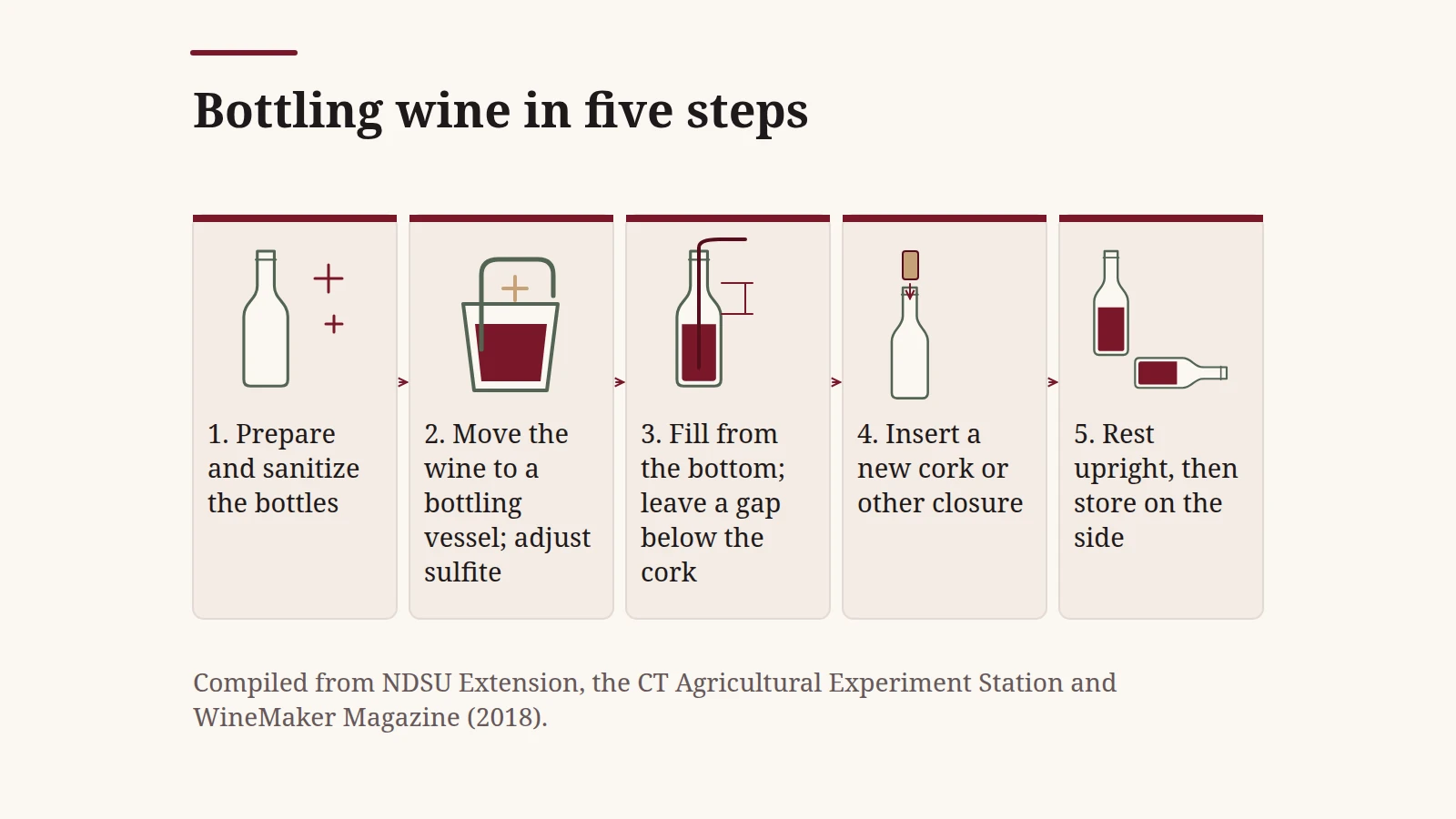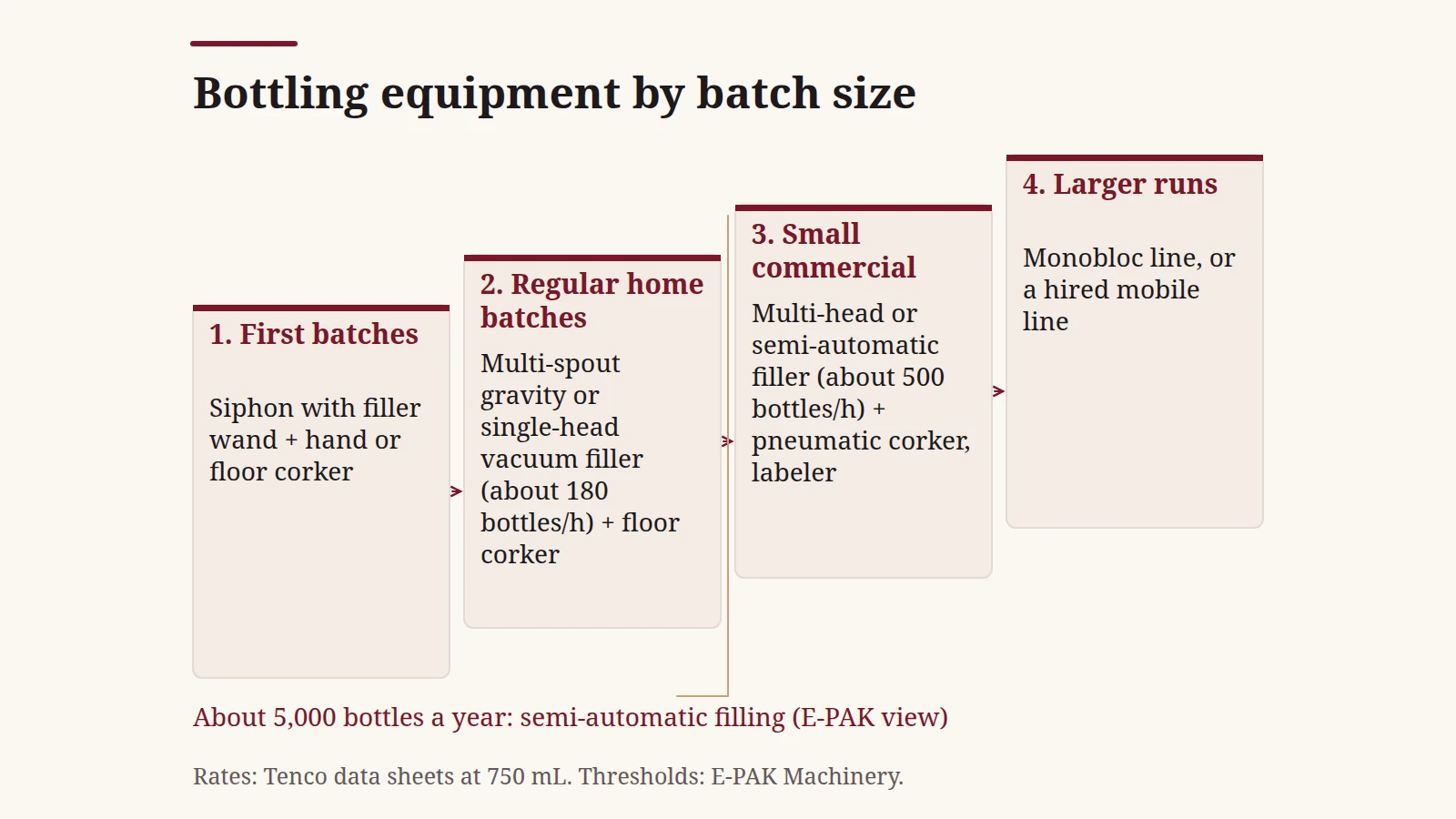
Buying bottling equipment for the wrong batch size wastes money twice: once on a machine that sits idle and again on the upgrade you needed instead. Choose wine bottling equipment stage by stage (prepare, fill, close, finish) and size it to the bottles you fill per session and per year; a siphon filler and floor corker cover a first batch, while a vacuum or multi-spout filler earns its place once bottling day runs to hundreds of bottles.
Wine bottling equipment is the set of tools that cleans, fills, closes and finishes bottles: a filler, a corker or capper, and optionally capsule, label and case-packing machines. Size it by bottles per session and per year. A gallon of wine fills about five 750 mL bottles (NDSU Extension), and a single-head vacuum filler is rated at about 180 bottles per hour for 750 mL bottles on its maker’s data sheet (Tenco, Enolmatic, read October 7, 2026). One equipment maker, E-PAK Machinery, says many winemakers move from manual to semi-automatic filling at around 5,000 bottles a year.
Compiled from public sources read on October 7, 2026 (listed at the end); models appear only as examples of published specifications, with no ranking, prices or testing of our own.
| Input or item | Typical value or source | Why it matters |
|---|---|---|
| Bottles per bottling session | Your volume × 5 bottles per gallon (NDSU Extension) | Sets the filling and corking workload for the day |
| Bottles per year | E-PAK says many winemakers go semi-automatic at about 5,000 a year and consider full automation above 9,000–10,000 (manufacturer view) | Signals when manual tools stop being practical |
| Filler rate at your bottle size | Tenco data sheets: about 180 bottles/h (single-head) and about 500 bottles/h (four-nozzle model) at 750 mL | Decides how long bottling day lasts |
| Fill method | Level (fills to a set height) or volumetric (doses a set volume) | Even appearance versus identical volume |
| Bottle neck and height | Example: Tenco’s single-head filler takes necks of 16–28 mm inside diameter and bottles 180–330 mm tall with the standard spout | Machines only fit bottles within their range, or with other spouts |
| Closure | Cork with a corker; roll-on screw caps need a capping machine | Chooses the closing tool |
| Sanitation | Winery lines: hot water at 180 °F (82 °C) at the coldest point for at least 20 minutes (Penn State), or 30 minutes (UC Davis presentation); home tools: the maker’s cleaning instructions | Filler, corker and bottle mouth are the main contamination points |
| Selling the wine? | Standard bottle sizes under 27 CFR 4.72; home wine must not be sold (27 CFR 24.75) | Commercial bottling adds legal requirements |
What does each bottling stage need?
Every bottling job, from a 5-gallon carboy to a winery line, goes through the same stages: preparing bottles, filling, closing, and finishing with capsules, labels and cases. What changes with scale is how much of each stage a machine does. The table maps the stages to equipment at three scales.
| Stage | Home batch | Larger home or club batch | Small commercial line |
|---|---|---|---|
| Prepare bottles | Bottle brush, sanitizer, drying rack | Bottle rinser or sanitizer sprayer | Rinser or sparger flushing bottles with inert gas |
| Move and filter wine | Siphon hose, racking cane | Pump or vacuum filler with inline filter | Bottling tank, pump, final filters |
| Fill | Filler wand on a siphon | Multi-spout gravity filler or single-head vacuum filler | Multi-head filler, often in a monobloc |
| Close | Hand or floor corker | Floor corker | Pneumatic corker or screw capper |
| Finish | Shrink capsules, printed labels | Capsules, labels by hand | Capsule spinner, labeler |
| Pack | Cases by hand | Cases by hand | Case packer and sealer |
| Sources | NDSU Extension; CT CAES | Tenco; WineMaker Magazine (2018, 2024) | UC Davis presentation (2019); Packaging Digest (2015) |
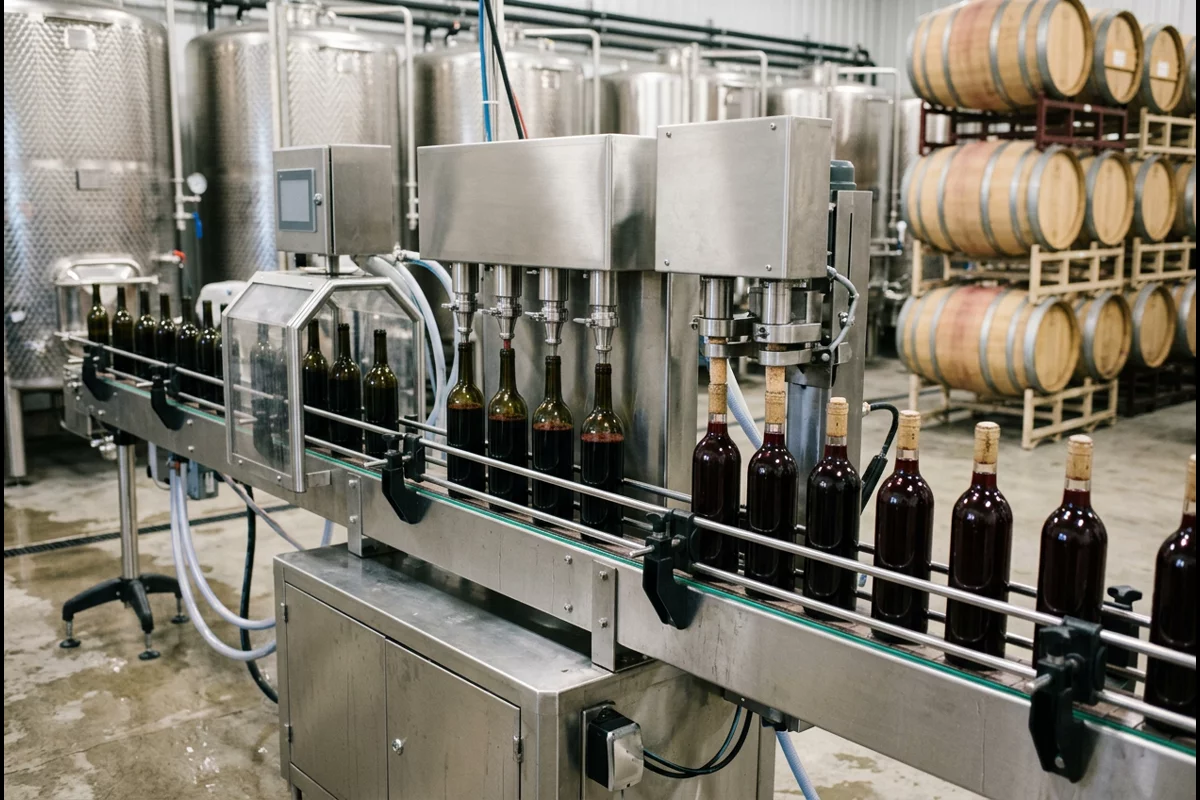
The stages stay in the same order at every scale, which is why the steps in our guide on how to bottle wine by hand map directly onto a machine line. Machines replace hands one stage at a time; they do not change what each stage has to achieve.
Takeaway: List the stages first and decide which ones you will mechanise; most small producers start with the filler and corker.
Which equipment fits your batch size?
Match the equipment to how many bottles you fill in one session and in a year. The four tiers below follow the sources’ descriptions; the boundaries are guides, not rules, and depend on how long you are willing to spend on bottling day.
| Tier | Typical situation | Filler | Closing | Source |
|---|---|---|---|---|
| 1. First batches | One carboy, about 25 bottles at a time | Siphon hose with a filler wand | Hand or floor corker (floor preferred) | NDSU Extension; CT CAES |
| 2. Regular home batches | Several carboys; up to the home limit of 100 or 200 gallons a year (500–1,000 bottles) | Multi-spout gravity filler, or a single-head vacuum filler (about 180 bottles/h at 750 mL) | Floor corker | WineMaker Magazine (2018); Tenco; NDSU Extension |
| 3. Small commercial | A few thousand bottles a year; E-PAK cites about 5,000 as a common point to go semi-automatic | Multi-head vacuum or semi-automatic filler (about 500 bottles/h at 750 mL for a four-nozzle model) | Semi-automatic (pneumatic) corker; labeler | E-PAK Machinery; Tenco; WineMaker Magazine (2024) |
| 4. Larger runs | Above roughly 9,000–10,000 bottles a year in E-PAK’s view, or when bottling time and oxygen control need a line | Monobloc rinser, filler and closer, or a hired mobile line | Corker or screw capper in the line | E-PAK Machinery; UC Davis presentation (2019); Packaging Digest (2015) |
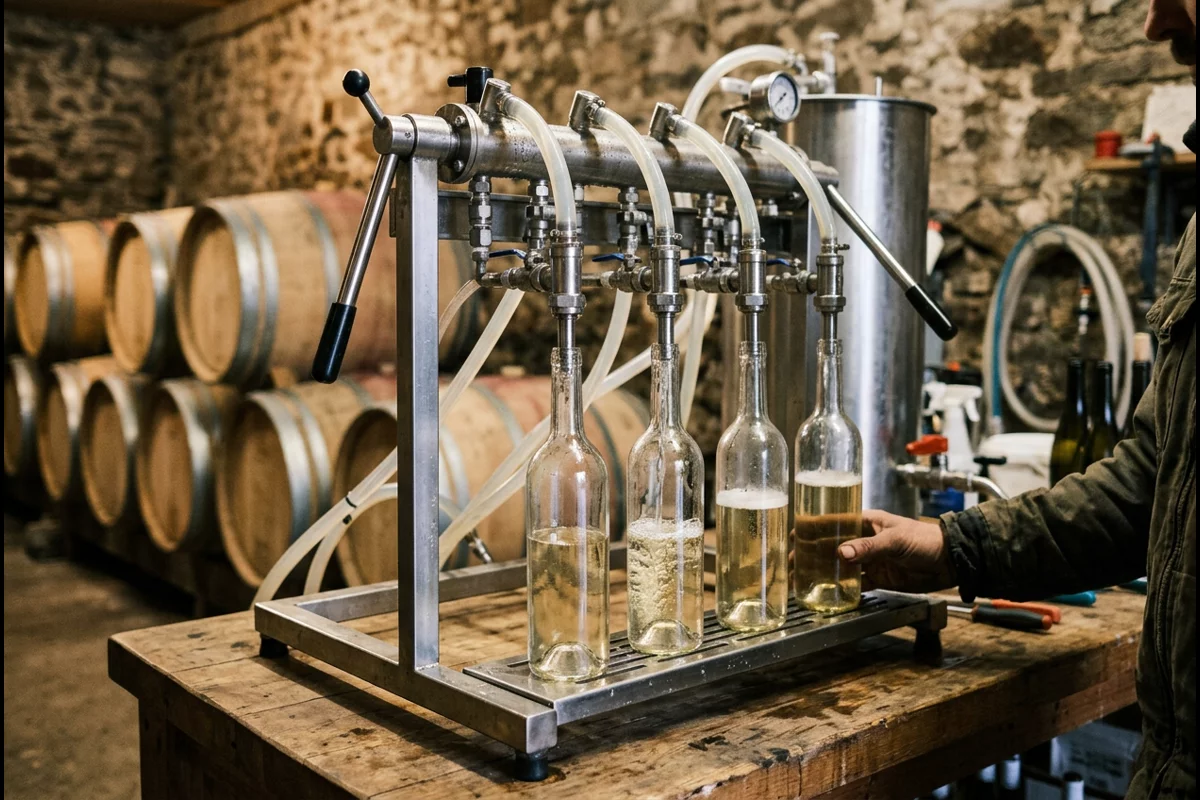
Home production has a legal ceiling. Federal rules cap tax-free home winemaking at 100 gallons a year for a one-adult household and 200 gallons for two or more adults, and the wine must not be sold (27 CFR 24.75); our home winemaking guide sets out the details. Tier 3 and 4 equipment is therefore mostly a commercial question.
Whatever the tier, you also need bottles, closures that match your closing system (new corks for corked wine) and sanitizer, as listed in the bottling-day checklist.
Takeaway: Count bottles per session and per year for a first cut, then let the slowest stage decide the final mix of machines.
How do the main filler types differ?
Fillers differ in what moves the wine (gravity, vacuum or a pump) and in what they control (the fill height or the volume). Level fillers bring every bottle to the same height, so a row of bottles looks even; volumetric fillers deliver the same volume, so levels vary with small differences in the glass (E-PAK Machinery).
| Filler | How it moves wine | Controls | Strengths | Limits | Source |
|---|---|---|---|---|---|
| Siphon hose with filler wand | Gravity siphon; valve opens when pressed on the bottle floor | Level (lifting the wand leaves the gap) | Simple; nothing to power | One bottle at a time; slow for large runs | WineMaker Magazine (2018); CT CAES |
| Multi-spout gravity filler | Siphon from a float-valve reservoir | Level: wine stops at the reservoir’s level | Several bottles at once | Must be gravity-fed; a pump can force the float valve open | WineMaker Magazine (2018) |
| Single-head vacuum filler (e.g. Tenco Enolmatic) | Vacuum pump draws wine into the bottle | Level, set by nozzle height | About 180 bottles/h at 750 mL; inline filter possible; can draw wine stored on the same level | Rigid bottles and clear, low-viscosity liquids only; one bottle at a time | Tenco data sheet and product page; WineMaker Magazine (2018) |
| Multi-nozzle vacuum filler (e.g. Tenco Enolmaster) | Vacuum, several nozzles | Level | About 500 bottles/h at 750 mL on the data sheet | Larger, commercial-grade unit | Tenco data sheet |
| Overflow (level) filler | Machine fills to a preset level | Level | Even appearance in clear bottles | Volume varies with the glass | E-PAK Machinery |
| Volumetric (timed) filler | Machine doses a set volume, often by timer | Volume | Same volume in every bottle | Levels look uneven across bottles | E-PAK Machinery |
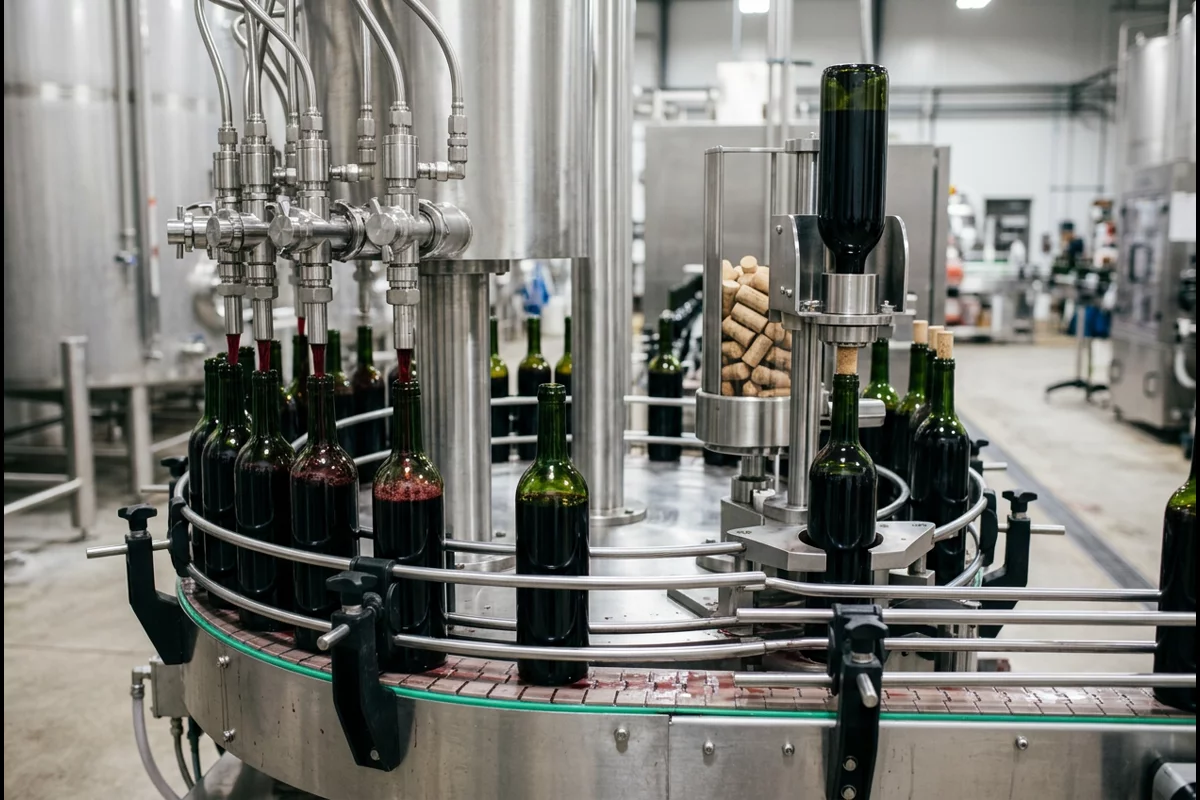
Common mistake: Assuming “gravity filler” means the same thing everywhere. E-PAK’s article groups gravity fillers with volumetric, timed fillers, while the home multi-spout gravity fillers described by WineMaker Magazine fill to a level. Ask each seller whether the machine controls level or volume.
The fill height you set on any of these machines still has to leave room below the cork; the fill-level guidance compares what different sources recommend.
Takeaway: Decide whether you need even levels or exact volumes, then choose the drive (gravity, vacuum or pump) that fits your space and speed.
How do corkers and other closing tools compare?
For corked still wine, the choice is between hand corkers, floor corkers and powered corkers; NDSU Extension prefers floor models over hand-held ones. Screw caps are a different system: roll-on caps are formed onto the bottle’s threads by a capping machine, which is why home bottlers rarely use them.
| Closing tool | How it works | Suits | Limits | Source |
|---|---|---|---|---|
| Hand (double-lever) corker | Two handles squeeze the cork into the neck | A few bottles | Tiring; bottles can slip | NDSU Extension; WineMaker Magazine (2024) |
| Floor corker | Lever compresses and drives the cork while the bottle stands on a base | Most home batches | Slow for thousands of bottles | NDSU Extension; WineMaker Magazine (2018) |
| Semi-automatic (pneumatic) corker | Compressed air drives the cork; operator places cork and bottle | Small commercial runs | Needs compressed air | WineMaker Magazine (2024) |
| Line corker in a monobloc | Automatic, multi-head | Winery lines | Part of a larger line | Packaging Digest (2015) |
| Roll-on screw capper | Rollers form the cap onto the bottle’s threads | Lines using screw caps | Needs screw-cap bottles and a machine | Packaging Digest (2015); WineMaker Magazine (2018) |
| Capsule tools | Heat-shrink capsules by hand; spinners pleat tin or aluminium capsules on lines | Finishing corked bottles | Cosmetic; not a seal | NDSU Extension; Packaging Digest (2015) |
Whatever the tool, corks must suit the bottle: NDSU recommends No. 9 corks for most US-made bottles. The closure comparison in the bottling guide covers the corks and caps themselves.
Takeaway: A floor corker covers home volumes; move to powered corking or screw caps only when volume or a commercial closure choice requires it.
When is it time to upgrade?
Upgrade when bottling day takes longer than you can work cleanly, when your annual volume crosses the levels equipment makers describe, or when you start selling wine. Each trigger points to a different next step, so name the trigger before choosing the machine.
| Trigger | How to tell | Next step | Source |
|---|---|---|---|
| Bottling day runs too long | Filling time alone at your rate exceeds the session (see example below) | Faster filler, or a second person on corking | Tenco rates; NDSU bottles per gallon |
| Annual volume grows | Around 5,000 bottles a year in E-PAK’s view | Semi-automatic filling; then check whether corking keeps up | E-PAK Machinery (filling); our suggestion for corking |
| Larger runs | Above about 9,000–10,000 bottles a year in E-PAK’s view | Fully automatic filling; compare owning a line with hiring a mobile one | E-PAK Machinery (filling); our suggestion for the rest |
| Oxygen or sanitation problems | Browning, refermentation or spoilage traced to bottling | Equipment that fills from the bottom, flushes with gas and cleans easily | UC Davis presentation (2019); Penn State (2015) |
| Selling the wine | Moving beyond the home exemption, which never allows sales | Check federal and state requirements first; wine sold in the US uses the standard sizes in 27 CFR 4.72 | 27 CFR 24.75; 27 CFR 4.72 |
Example, assumed inputs: a 100-gallon year bottled in one session is about 500 bottles. At the single-head vacuum filler’s data-sheet rate of about 180 bottles per hour for 750 mL, filling alone takes about 2.8 hours; 1,000 bottles take about 5.6 hours, or about 2 hours at the four-nozzle model’s 500 bottles per hour. Corking, labelling, set-up and cleaning come on top, and real rates depend on the wine and bottle.
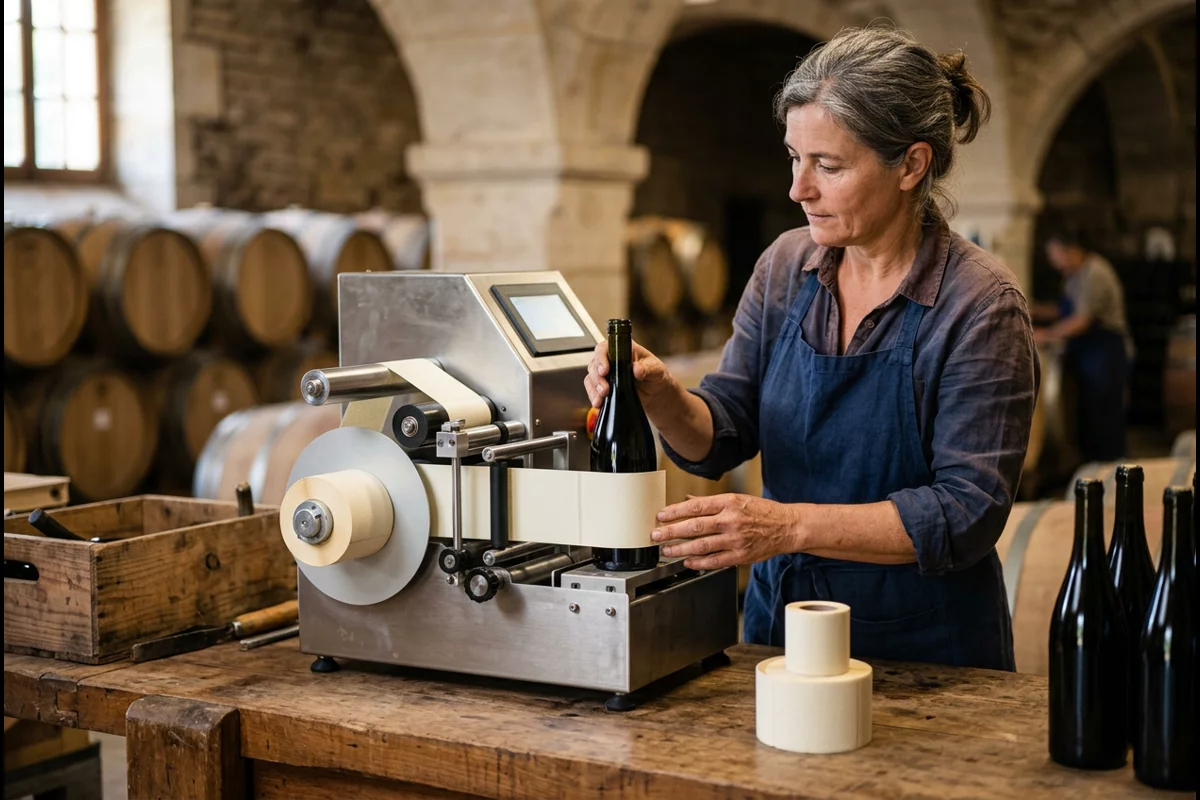
Takeaway: Upgrade for a named reason, time, volume, quality or sales, and buy the machine that fixes that reason.
What does a small-winery bottling line include?
A winery bottling line moves wine from a bottling tank through final filters to a bottle rinser or sparger, a filler, a doser for liquid or gas, a corker or screw capper, a labeler and a case packer, according to a UC Davis bottling-readiness presentation (2019). Owning a line is not the only route: Virginia Cooperative Extension’s bottling bulletin addresses both wineries that bottle themselves and those working with a bottling partner, and points to guidance on quality tracking with mobile lines.
| Line element | Job | Check named in the sources | Source |
|---|---|---|---|
| Bottling tank and final filters | Holds bottle-ready wine; final filtration | Filter integrity (bubble point) before and after bottling | UC Davis presentation (2019); Penn State (2015) |
| Rinser or sparger | Rinses bottles or flushes them with inert gas | Rinser parts at the bottle mouth sprayed with 70% food-grade ethanol | UC Davis presentation (2019); Penn State (2015) |
| Filler | Fills to the set point | Dissolved oxygen under 1 mg/L at start-up and pickup under 0.3 mg/L; fill height | UC Davis presentation (2019) |
| Corker or screw capper | Seals the bottle | Vacuum in the bottle (−5 to 0 inches of mercury); cork height; cap torque | UC Davis presentation (2019) |
| Labeler and case packer | Labels and packs | Label placement; case print | UC Davis presentation (2019) |
| Whole line | Sanitation | Filtered steam or 180 °F water for at least 30 minutes before each bottling day (UC Davis); 180 °F for at least 20 minutes at the coldest point (Penn State) | UC Davis presentation (2019); Penn State (2015) |
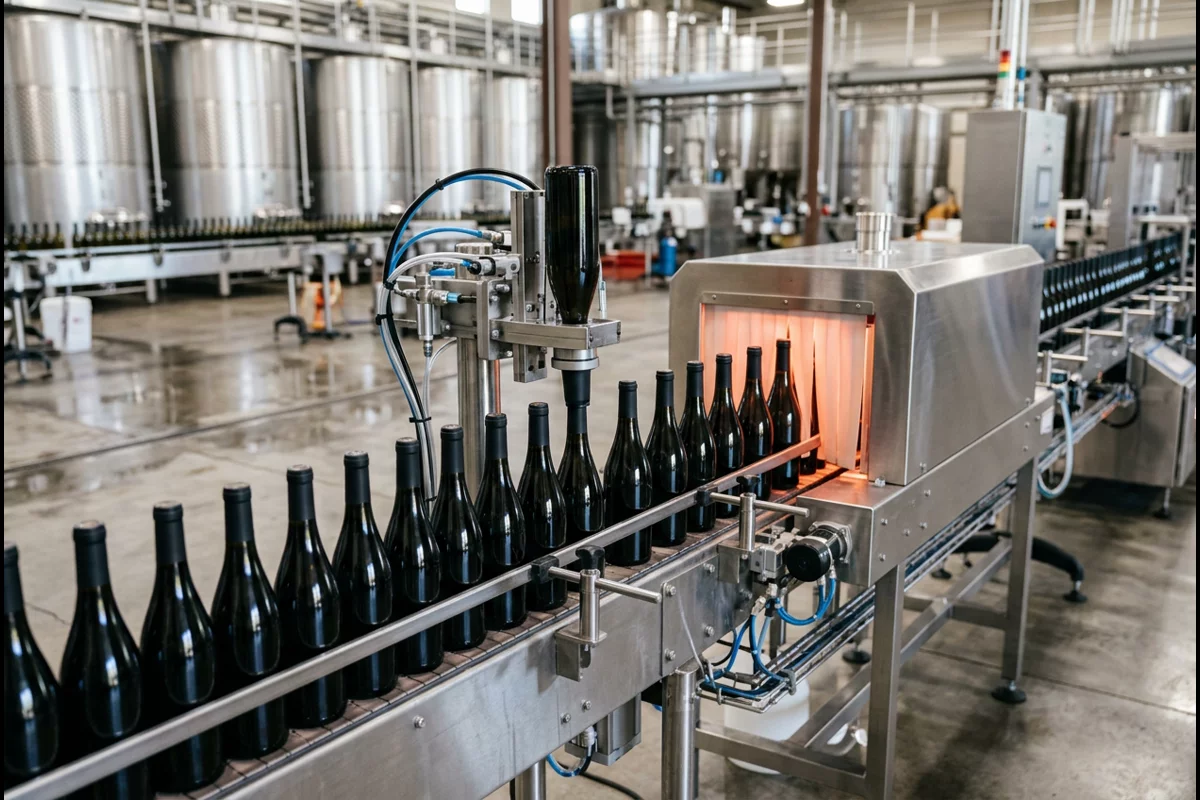
The same presentation recommends planning a bottling at least eight weeks ahead and checking vacuum, fill height, dissolved oxygen, temperature, cork height and label placement every 15–30 minutes during a run. A full automatic line of the kind Packaging Digest described at a Missouri winery in 2015 adds a monobloc that rinses, fills, corks and caps in one machine, nitrogen flushing before filling, a capsule spinner, a labeler, a case packer, a case sealer and a palletizer. Other filling and closure topics are collected in the Bottling section.
Takeaway: Treat a line as a series of checkpoints, oxygen, fill, seal and sanitation, and judge any line, owned or hired, by those checks.
What should you check before buying?
Before buying, check that the machine fits your bottles and closures, controls what you need (level or volume), can be cleaned at every point that touches wine, and reaches the rate you need at your bottle size, not just its headline rate. The checklist below turns those points into questions for the seller.
| Check | Question to ask | Why | Source |
|---|---|---|---|
| Bottle fit | What neck diameters and bottle heights does it take? | Example: Tenco’s single-head filler takes 16–28 mm inside neck diameters and 180–330 mm bottles with the standard spout; other spouts change this | Tenco data sheet and product page |
| Container type | Does it need rigid bottles? | Vacuum fillers draw air out of the container | Tenco product page |
| Level or volume | Does it fill to a level or dose a volume? | Terms vary between sellers | E-PAK Machinery; WineMaker Magazine (2018) |
| Real rate | What is the rate for 750 mL bottles of wine? | Tenco quotes up to 250 bottles/h for the Enolmatic but about 180 for 750 mL on the data sheet | Tenco data sheet |
| Cleanability | Can every wine-contact part be reached, cleaned and sanitized? | Filler spouts, corker and bottle mouth are the main contamination points | Penn State (2015) |
| Feed | Gravity, vacuum or pump? Where must the wine sit? | Gravity fillers need the wine above them; vacuum fillers can draw wine stored on the same level | WineMaker Magazine (2018); Tenco |
| Filtration | Can a filter be connected inline? | Filtering while filling saves a step | Tenco product page |
| Closure | Corks, screw caps or both? | Screw caps need a capping machine and threaded bottles | Packaging Digest (2015) |
| Power and air | Voltage? Compressed air? | Pneumatic corkers need an air supply | WineMaker Magazine (2024); Tenco data sheet |
Common mistake: Comparing machines by their headline speed. Tenco’s own pages give up to 250 bottles per hour for the Enolmatic in general and about 180 for 750 mL wine bottles; compare every machine at your bottle size and liquid.
Before bottling day itself, the ready-to-bottle checks confirm the wine is stable enough to go into bottles, and the fermentation completion checks come before that.
Takeaway: Ask every seller the same nine questions, and compare answers at your own bottle size.
When this does not apply
This page covers still wine in glass bottles, from home batches to small commercial runs. It does not cover:
- Sparkling wine. Pressure-rated bottles, counter-pressure filling and cages need different equipment.
- Cans, kegs and bag-in-box. Each has its own filling equipment.
- Prices and brands. Models named here illustrate published specifications; the page does not rank or price them.
- Legal advice. Selling wine is outside the home exemption; check TTB and state requirements before buying equipment for it.
Rates and thresholds are manufacturer statements under their stated conditions; confirm them with the seller for your wine and bottles. For other topics, browse all articles.
Takeaway: Use the tiers and checklist for still wine in bottles, and look for specialist guidance for other formats.
How this page was put together
We compiled this page from Tenco’s product pages and data sheets for two vacuum fillers, an E-PAK Machinery article on choosing wine fillers (2022), a UC Davis bottling-readiness presentation (2019), Penn State Extension’s bottling notes (2015), Virginia Cooperative Extension’s bottling bulletin, NDSU Extension’s home winemaking publication, WineMaker Magazine’s bottling guides (2018, 2024) for descriptions of home equipment, a 2015 Packaging Digest report on a winery line and the federal rules in 27 CFR, all read on October 7, 2026. Manufacturer figures are reported as the manufacturers state them; we did not test any equipment.
Takeaway: Read every rate and threshold as the named source’s claim, and confirm it for your own bottles.
Related reading:
- How to bottle wine — Follow the five bottling steps these tools carry out.
- Home winemaking for beginners — See the full process and the legal limits that cap home volumes.
- Wine fermentation explained — Confirm the wine has finished fermenting before any equipment touches it.