Bottling wine with a cylindrical cork without leakage, premature oxidation, or hydraulic cork push-out requires matching a 24.0 mm (#9) or 22.0 mm (#8) stopper to the bottle’s 18.5 mm CETIE internal neck bore, leaving a temperature-calibrated 15 mm to 20 mm headspace (ullage) gap below the cork base, pre-compressing the cylinder radially to 15.5 mm to 16.0 mm in an iris floor corker before driving it 1.0 mm to 1.5 mm below the glass rim, and resting the sealed bottles upright for 48 to 72 hours. This specification governs still wine packaged in standard 750 mL and 375 mL glass wine bottle types across small-batch home winemaking and micro-winery cellar runs.
Bottling still wine with cork relies on three coupled mechanical tolerances: a 20% to 25% sustained radial diameter compression inside the glass neck (5.5 mm interference for a 24 mm #9 cork in an 18.5 mm CETIE GME 50.01 finish), a 15 mm to 20 mm linear gas space (4.8 mL to 7.5 mL at 20 °C / 68 °F) to absorb the +22 to +36 psig piston insertion spike and liquid thermal expansion, and a two-stage iris compression stroke that squeezes the dry or sulfite-humidified stopper to 15.5 to 16.0 mm prior to vertical plunger contact. Skipping pre-compression or laying bottles down before the 48-hour viscoelastic suberin relaxation completes creates permanent capillary weep channels.
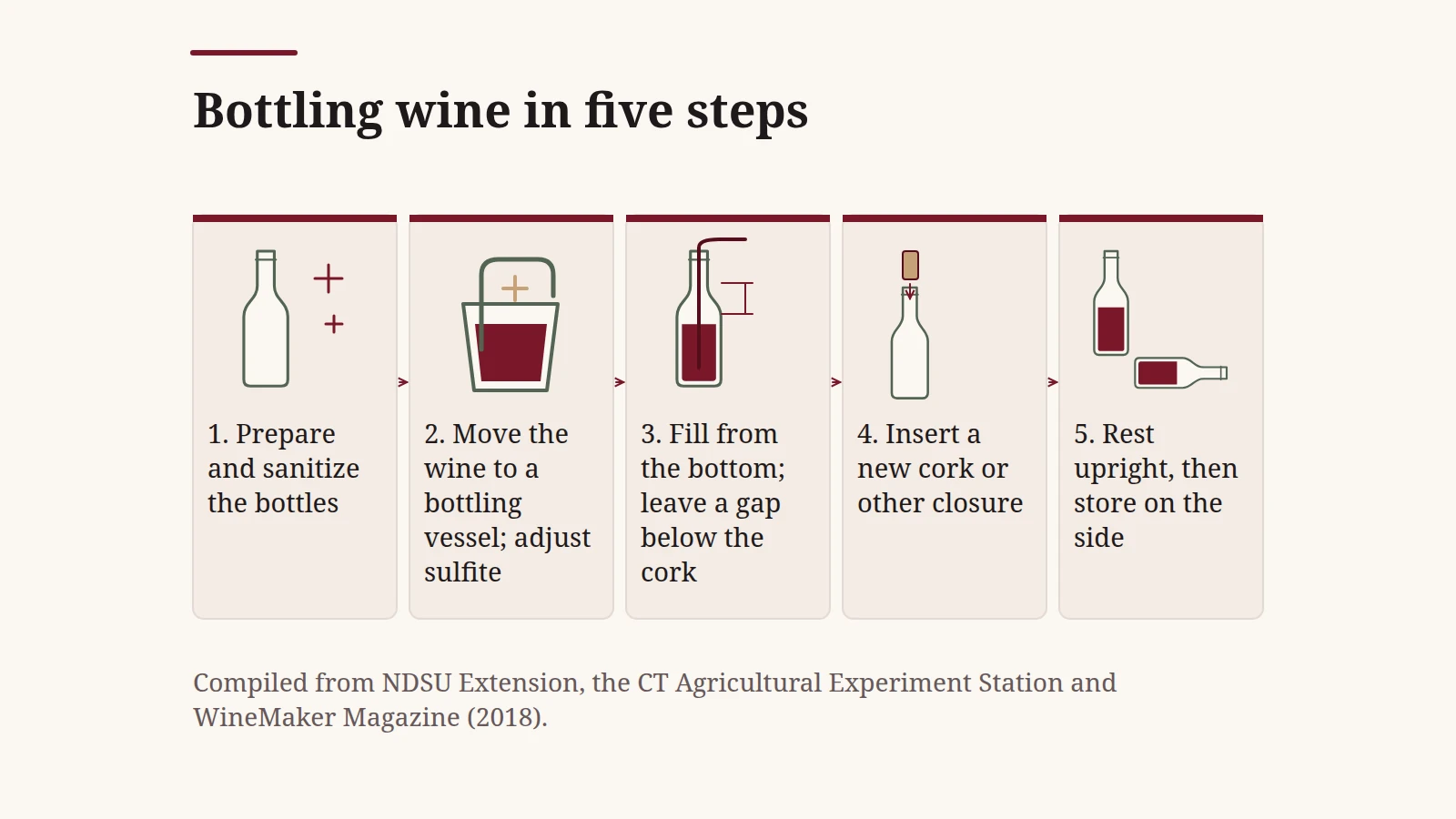
Whereas our general overview on how to bottle wine covers pre-bottling fermentation readiness, sulfite targets, and the five-stage bottling-day workflow, this engineering reference isolates the physical interface between the glass neck bore, the cork cylinder, the corker iris jaws, and the headspace gas column.
| Engineering Parameter | Target Specification | Physical Failure Mode if Violated | Reference Standard / Source |
|---|---|---|---|
CETIE Mouth Bore (D1 at 3 mm depth) |
18.5 mm +/- 0.5 mm (18.0 to 19.0 mm) |
Bore >19.0 mm drops #8 radial compression below 14%, causing wet seepage and rapid oxidation |
CETIE GME 50.01 / EN 12726; AWRI |
| Controlled Sealing Zone (3 to 45 mm depth) | 18.0 to 19.5 mm (<= 20.0 mm at 45 mm; ovality <= 0.5 mm) |
Out-of-round necks or bell taper above 44 mm break lower cork edge contact | CETIE GME 50.01; Diam Bouchage |
#9 Cork Radial Compression (24.0 mm OD) |
5.5 mm interference (22.9% in-neck; 33.3% in 16 mm jaws) |
Exceeding 33% to 35% sustained compression crushes suberin cell walls plastically |
AWRI; Scott Laboratories |
#8 Cork Radial Compression (22.0 mm OD) |
3.5 mm interference (15.9% in-neck; 27.3% in 16 mm jaws) |
Low radial normal force limits shelf life to 6 to 18 months in 18.5 mm necks |
NDSU Extension; WineMaker Magazine |
| Linear Ullage (Cork Base to Meniscus, 20 °C) | 15 mm to 20 mm (4.8 to 7.5 mL gas volume, non-vacuum) |
Ullage <10 mm spikes piston insertion pressure above 6.6 bar abs (+81 psig), causing cork bounce |
AWRI; Scott Laboratories; CT CAES |
| Rim-to-Meniscus Fill Depth (44 mm cork) | 60.5 mm to 65.5 mm below top glass finish at 20 °C (68 °F) |
Cold wine (10 °C) filled to 60 mm expands +2.6 to +3.2 mL at 24 °C, pushing corks out |
Scott Laboratories; UC Davis (2019) |
| Iris Jaw Pre-Compression Diameter | 15.5 mm to 16.0 mm uniform cylinder before plunger stroke |
Conical hand corkers (17.8 mm exit) fold longitudinal wormhole creases down #9 corks |
AWRI; Diam Bouchage; WineMaker (2018) |
| Cork Top Recess Below Rim | 1.0 mm to 1.5 mm (1/32 to 1/16 in) recessed below finish |
Proud corks tear capsules; deep recess (>2.5 mm) steals headspace and traps rinse water |
AWRI; Scott Laboratories |
| Factory Cork Moisture & Coating | 5% to 8% moisture; 16 to 18 mg paraffin/silicone coat |
Boiling (100 °C) melts paraffin (46 to 68 °C) and waterlogs lenticels, causing torn extractions |
AWRI; WineMaker Magazine (2018) |
| Post-Corking Upright Recovery | 48 to 72 hours upright at 15 to 20 °C before horizontal racking |
Immediate side storage drives wine through unrelaxed micro-capillaries under +20 to +35 psi |
NDSU Extension; CT CAES; AWRI |
How do CETIE bottle neck geometry and wine bottle types govern cork sizing?
Standard 750 mL wine bottle types built to the European CETIE GME 50.01 (EN 12726 Bague Plate Unique) and Glass Packaging Institute (GPI) finishes have a nominal internal mouth diameter (D1) of 18.5 mm +/- 0.5 mm (18.0 mm to 19.0 mm) measured 3 mm below the top rim, paired with a controlled sealing zone extending from 3 mm to 45 mm depth where the internal diameter remains within 18.0 mm to 19.5 mm (maximum conicity <= 20.0 mm at 45 mm depth and maximum ovality <= 0.5 mm). Selecting the right wine bottling supplies starts with matching your cork diameter and length to that internal glass profile.
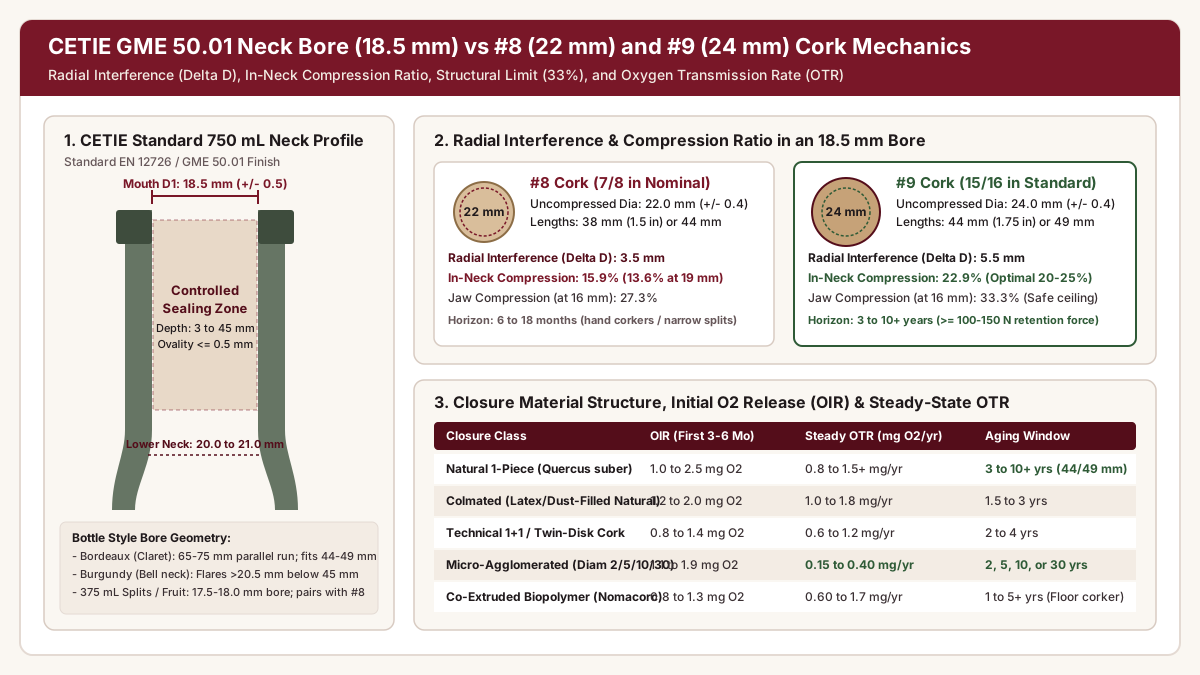
While the outer rim looks similar across commercial glass, the internal taper below 40 mm varies significantly across the three main wine bottle types:
- Standard 750 mL Bordeaux (Claret) Bottles: Feature a long, parallel-walled cylindrical neck (
65 mm to 75 mmstraight run before the sharp shoulder break). The internal bore holds near18.5 mmat the mouth and widens gradually to20.0 mm to 21.0 mmin the lower neck ullage zone. Bordeaux necks accommodate38 mm,44 mm, and extra-long49 mm#9(24 mmdiameter) corks with uniform radial contact along the entire cylinder. - Standard 750 mL Burgundy and Rhone (Sloped-Shoulder) Bottles: Feature a shorter cylindrical upper neck that flares more rapidly into a bell-shaped or conical lower profile below
40 mm to 45 mmdepth. These bottles pair cleanly with38 mmand44 mm x 24 mm(#9) corks. However, the Australian Wine Research Institute (AWRI) warns that extra-long49 mmclosures in bell-necked bottles require bore verification because the bottom5 mmof the cork can sit where the glass flares past20.5 mm, reducing lower-edge radial seal pressure and allowing wine to wick upward around the base. - 375 mL Half-Bottles (Splits), Narrow Imported Necks, and Dessert Bottles: Many European 375 mL splits and specialty fruit-wine bottles have a narrower
17.5 mm to 18.0 mminternal mouth bore or a shorter straight neck column. Driving a24.0 mm(#9) cork into a17.5 mmbore forces27.1%sustained in-neck compression and>35%jaw compression, making#8(22.0 mm x 38 mm) corks the mechanically sound fit.
Radial interference math: #8 (22 mm) vs #9 (24 mm) corks
A cylindrical cork seals by outward radial normal force generated when its compressed polyhedral suberin honeycomb pushes against the glass wall. The radial interference (Delta_D) and linear radial compression ratio (C_radial) are defined by:
Delta_D = D_cork_uncompressed - D_neck_bore
C_radial (%) = ((D_cork_uncompressed - D_target) / D_cork_uncompressed) * 100
Cellular mechanics research cited by AWRI and Diam Bouchage establishes that natural cork tissue (Quercus suber, containing approximately 40 million closed air-filled suberin cells per cubic centimeter) safely withstands up to 30% to 33% sustained diameter reduction inside a bottle neck and up to 33% to 35% brief transient compression inside corker jaws. Exceeding 35% compression crushes the corrugated suberin cell walls plastically, permanently destroying elastic rebound and creating axial leak channels.
Applying the compression equation to a standard 18.5 mm CETIE bore reveals why #8 and #9 corks serve completely different cellaring horizons:
- Worked Example 1 -
#8Cork (22.0 mmnominal OD) in an18.5 mmNeck:Delta_D = 22.0 mm - 18.5 mm = 3.5 mmradial interference.C_radial (in-neck) = ((22.0 - 18.5) / 22.0) * 100 = 15.9%sustained compression. If the glass bottle sits at the wide+0.5 mmCETIE manufacturing tolerance (19.0 mmbore), in-neck compression drops to((22.0 - 19.0) / 22.0) * 100 = 13.6%. Inside16.0 mmfloor corker jaws, transient compression is only((22.0 - 16.0) / 22.0) * 100 = 27.3%. Because13.6% to 15.9%in-neck compression exerts lower outward radial pressure against the glass, oxygen permeation increases and moderate cellar warming can push wine past the cork. Limit#8corks in standard 750 mL bottles to short-term consumption (6 to 18 months). - Worked Example 2 -
#9Cork (24.0 mmnominal OD) in an18.5 mmNeck:Delta_D = 24.0 mm - 18.5 mm = 5.5 mmradial interference.C_radial (in-neck) = ((24.0 - 18.5) / 24.0) * 100 = 22.9%sustained compression (remaining within the optimal20.8% to 25.0%sealing window across the entire18.0 mm to 19.0 mmCETIE tolerance band). Inside16.0 mmfloor corker jaws, transient compression reaches((24.0 - 16.0) / 24.0) * 100 = 33.3%, sitting right at the safe elastic ceiling without crushing cell walls. This5.5 mminterference maintains>= 100 to 150 Nextraction retention force and supports aging from2 to 3 years(24 x 38 mm) to3 to 5+ years(24 x 44 mm) and5 to 10+ years(24 x 49 mm).
Conditional sizing rule: If your bottle bore measures 18.0 mm to 19.0 mm and planned storage exceeds 12 to 18 months, prioritize 24.0 mm (#9) corks (44 mm or 49 mm length) applied with an iris floor corker. If you are sealing narrower 17.5 mm splits or only have a twin-lever hand corker for wine consumed within 12 months, select 22.0 mm x 38 mm (#8) corks.
How do natural, colmated, technical, micro-agglomerated, and synthetic corks compare on oxygen transfer?
Beyond diameter and length, closure material structure controls two distinct oxygen metrics described in Echave et al. (2021) and closure manufacturer data sheets: Initial Oxygen Release (OIR), which is the 0.8 mg to 2.5 mg of compressed atmospheric oxygen squeezed out of the cork’s surface lenticels and cell matrix into the wine during the first 3 to 6 months after bottling, and steady-state Oxygen Transmission Rate (OTR), measured in milligrams of oxygen per year (mg O2/year) after month 12.
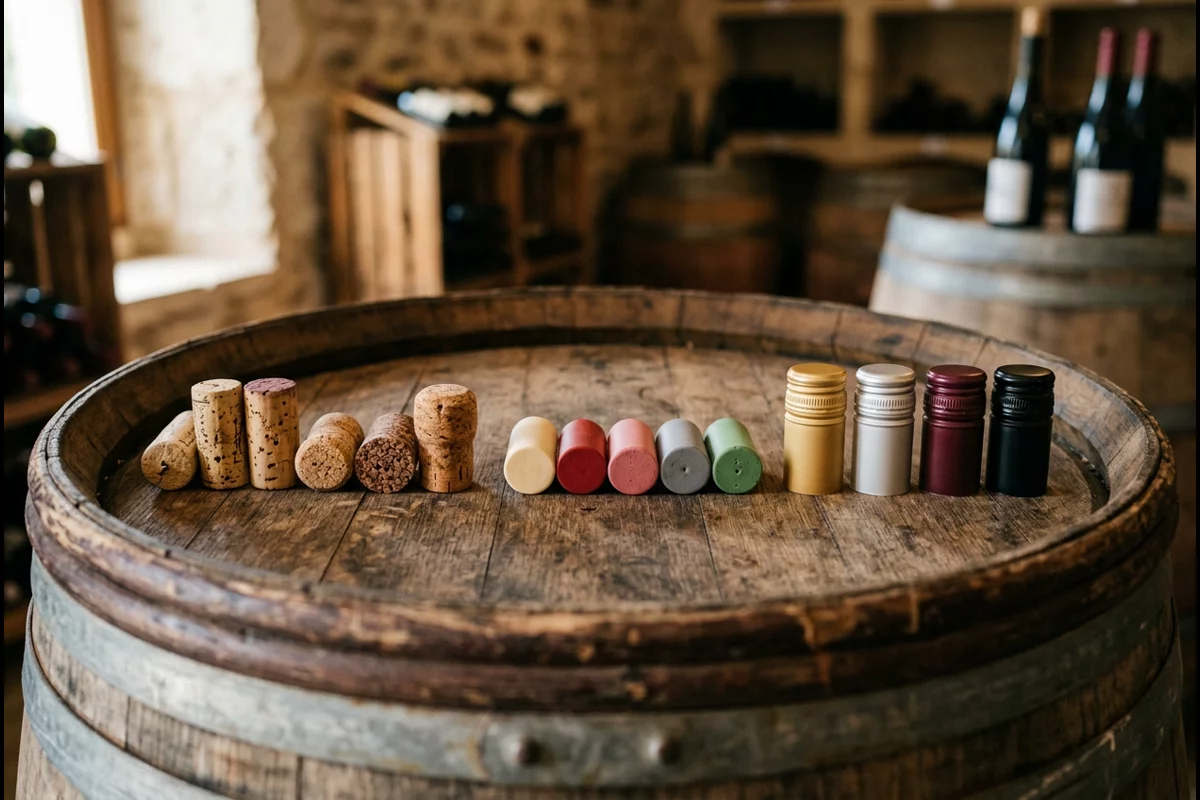
Each mg of dissolved oxygen consumes roughly 4 mg/L (4 ppm) of free sulfur dioxide (SO2) in wine. Selecting a high-OTR closure for a delicate white wine with borderline free SO2 accelerates browning and flat aroma loss; check our winemaking SO2 management guide to align your pre-bottling sulfite target with your closure’s oxygen ingress profile.
| Closure Category | Material & Cellular Structure | Initial O2 Release (First 3-6 Mo) | Steady-State OTR (mg O2/yr) | Aging Horizon | Corker Requirement & Failure Risk |
|---|---|---|---|---|---|
Natural One-Piece Cork (24 x 44 mm or 49 mm) |
Whole cylinder punched from boiled Quercus suber bark; ~40M polyhedral cells/cm3 (45%-60% suberin) |
1.0 to 2.5 mg O2 |
0.8 to 1.5+ mg/yr (wider natural grain variance: 0.1 to >3.0) |
3 to 10+ years (by grade: Flor, Extra, Super, 1st) |
Floor corker recommended; low-grade porous bark can weep through axial lenticels if under-compressed |
Colmated Natural Cork (22 or 24 x 38-44 mm) |
Medium-porosity natural cork with surface lenticels sealed by cork dust and food-grade natural latex/resin glue | 1.2 to 2.0 mg O2 |
1.0 to 1.8 mg/yr |
1.5 to 3 years |
Compresses smoothly in both Portuguese nylon and Italian brass floor corkers; boiling dissolves filler glue |
Technical Cork (1+1 / Twin-Disk / Twin-Top) |
High-density agglomerated granule core with intact natural cork disks laminated onto one or both ends | 0.8 to 1.4 mg O2 |
0.6 to 1.2 mg/yr (more uniform than low-grade natural) |
2 to 4 years |
Dense agglomerate center resists hand corkers; requires a 3-jaw or 4-jaw iris floor corker |
Micro-Agglomerated Supercritical CO2 (e.g., Diam 2, 3, 5, 10, 30) |
Purified micro-granules treated with supercritical CO2 (<0.3 ng/L releasable TCA) bound with polyurethane microspheres |
1.1 to 1.9 mg O2 |
0.15 to 0.40 mg/yr (Diam 2: ~0.40; Diam 5: ~0.29; Diam 10/30: ~0.15-0.25) |
2, 3, 5, 10, or 30 years by model |
High elastic modulus demands a rigid 4-jaw floor corker (15.5-16.0 mm iris); hand corkers stall or gouge top |
| Co-Extruded Biopolymer / Synthetic (e.g., Nomacorc Select Green / Reserva) | Foamed closed-cell polyethylene or sugarcane biopolymer core inside an elastic co-extruded outer skin | 0.8 to 1.3 mg O2 |
0.60 mg/yr (Reserva) to 1.2-1.7 mg/yr (Select Green 300/500) |
1 to 5+ years (up to 10 yrs for Reserva) |
Zero TCA risk and can store upright, but worn nylon jaws leave vertical pinch seams that leak air |
How do twin-lever hand corkers and iris floor corkers differ in jaw compression kinematics?
The mechanical difference between a twin-lever hand corker and a floor corker is whether radial compression is coupled to or decoupled from vertical insertion. As WineMaker Magazine’s bottling guide (Bob Peak, 2018) and NDSU Extension (FN1638) emphasize, floor corkers outperform hand-held lever models because they compress the entire cork length before moving it downward.
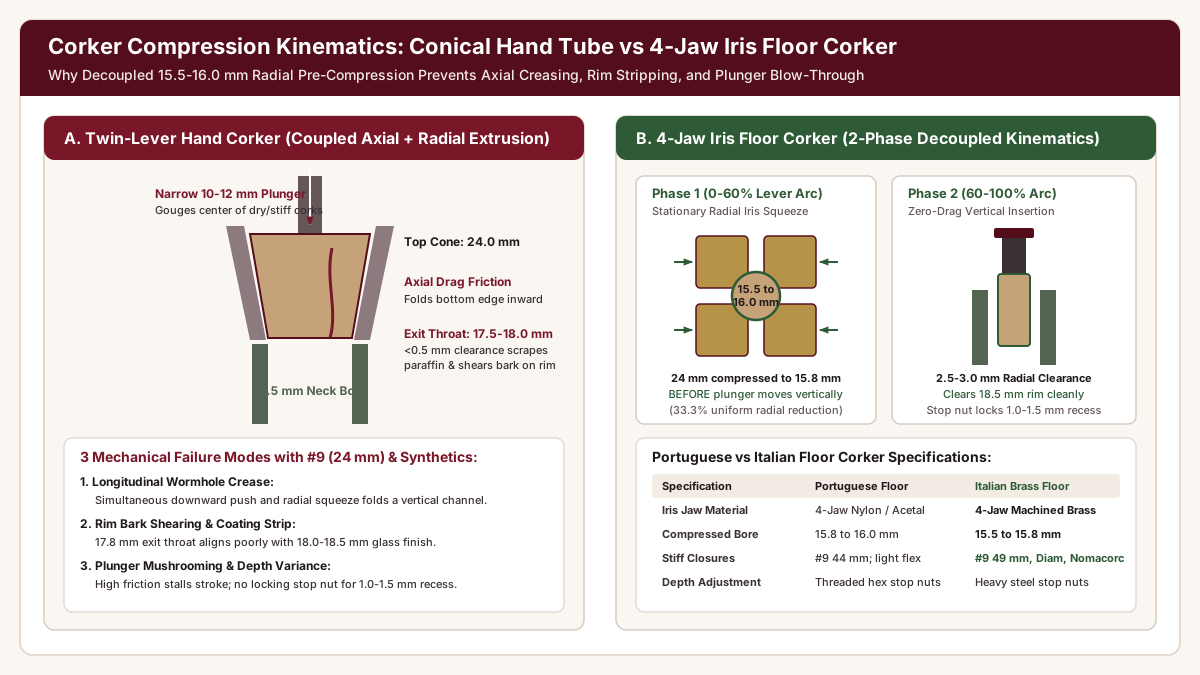
Why conical twin-lever hand corkers crease #9 and synthetic corks
A double-lever hand corker lacks radial iris jaws. Instead, it positions a tapered metal or plastic funnel cone (~24 mm top opening narrowing to a ~17.5 mm to 18.0 mm exit throat) over the bottle mouth. Pulling the two side handles downward forces a narrow (10 mm to 12 mm) plunger rod to ram the cork through the narrowing cone and into the bottle neck in a single combined stroke. When used on 24.0 mm (#9) corks, 49 mm corks, or stiff synthetic and micro-agglomerated closures, three mechanical failures occur:
- Simultaneous axial + radial shear (“wormhole” creasing): Because the cork is compressed only as it is dragged vertically against the cone walls, high axial friction folds the bottom edge of a
24 mmstopper inward. This creates a permanent longitudinal crease (score line) along the side of the cork that leaks wine once the bottle is laid horizontally. - Rim bark shearing and lubricant stripping: The cone’s exit throat (
17.5 mm to 18.0 mm) is barely narrower than an18.0 mm to 18.5 mmbottle mouth. Any slight off-center tilt shears off a crescent of cork bark or strips the16 mg to 18 mgparaffin/silicone coating against the glass finish rim. - Plunger blow-through and mushrooming: With corks longer than
44 mm, dry corks (<5%moisture), or dense technical/synthetic closures, the narrow plunger punches deep into the top center of the stopper before the side levers generate enough mechanical advantage to extrude the cylinder through the cone.
Two-phase iris floor corker mechanics (Portuguese vs Italian models)
A floor corker (and commercial pneumatic or monobloc corking heads covered in our wine bottling equipment guide) separates compression and insertion into two distinct phases inside a stationary horizontal compression box:
- Phase 1 - Stationary Radial Pre-Compression (First
60%of Lever Arc): As the operator pulls the floor lever down through the first60%of its travel, three or four beveled iris segments slide radially inward along angled cam tracks. They squeeze the full length of the24.0 mmcork uniformly down to a smooth cylinder of15.5 mm to 16.0 mmdiameter (33.3%transient compression) before the vertical plunger pin touches the top of the cork. - Phase 2 - Zero-Drag Vertical Insertion (Final
40%of Lever Arc): Once the iris locks at15.5 mm to 16.0 mm, the wide-faced plunger drives the pre-compressed cork straight down into the18.5 mmbottle neck. Because the compressed stopper is2.5 mm to 3.0 mmnarrower than the glass mouth, it clears the top finish rim with zero axial scraping and expands outward only after seating inside the neck.
| Mechanical Parameter | Twin-Lever Conical Hand Corker | Portuguese Floor Corker | Italian Brass-Jaw Floor Corker |
|---|---|---|---|
| Compression Mechanism | Tapered plastic/stamped metal funnel cone (no iris) |
4-jaw (or 3-jaw) molded nylon / polyacetal (POM) iris blocks |
4-jaw precision-machined solid brass iris blocks |
| Pre-Insertion Compressed Bore | 17.5 to 18.0 mm extruded under vertical drag load |
15.8 to 16.0 mm stationary radial pre-compression |
15.5 to 15.8 mm stationary radial pre-compression |
Clearance Inside 18.5 mm Rim |
0.0 to 0.5 mm (high rim shear risk) |
2.5 to 2.7 mm total radial clearance |
2.7 to 3.0 mm total radial clearance |
| Jaw Seam & Scoring Risk | High on #9 (24 mm), technical, and synthetic corks |
Low when new; nylon blocks can flex or burr after heavy use, leaving faint seam lines on stiff synthetics | Minimal; rigid brass jaws hold tight sliding tolerances on #9 (44-49 mm), Diam, and Nomacorc |
| Insertion Depth Adjustment | Non-locking collar / manual feel (high depth variance) | Threaded plunger rod with dual locking hex nuts + spring base | Heavy threaded steel plunger rod with locking stop nuts + heavy frame |
| Recommended Closure Scope | #8 (22 x 38 mm) natural or colmated corks (<100 bottles) |
#8 and #9 (24 x 38-44 mm) natural, colmated, and 1+1 corks |
All #9 (24 x 44-49 mm) natural, Diam 2/5/10/30, and co-extruded synthetics |
Per AWRI’s cylindrical closure operations guide and Diam Bouchage’s technical manual, inspect floor corker iris jaws before each bottling run by closing the empty handle halfway and checking that the four sliding blocks meet cleanly without stepped corners, metal burrs, or >0.2 mm inter-jaw gaps.
How do you calculate bottle headspace (ullage), piston insertion pressure, and thermal expansion?
Leaving the right gas space below the cork prevents two common hydraulic failures: immediate cork bounce (caused by trapped air compressed during cork insertion) and delayed weeping or cork push-out (caused by liquid wine expanding when cellar or transport temperatures rise).
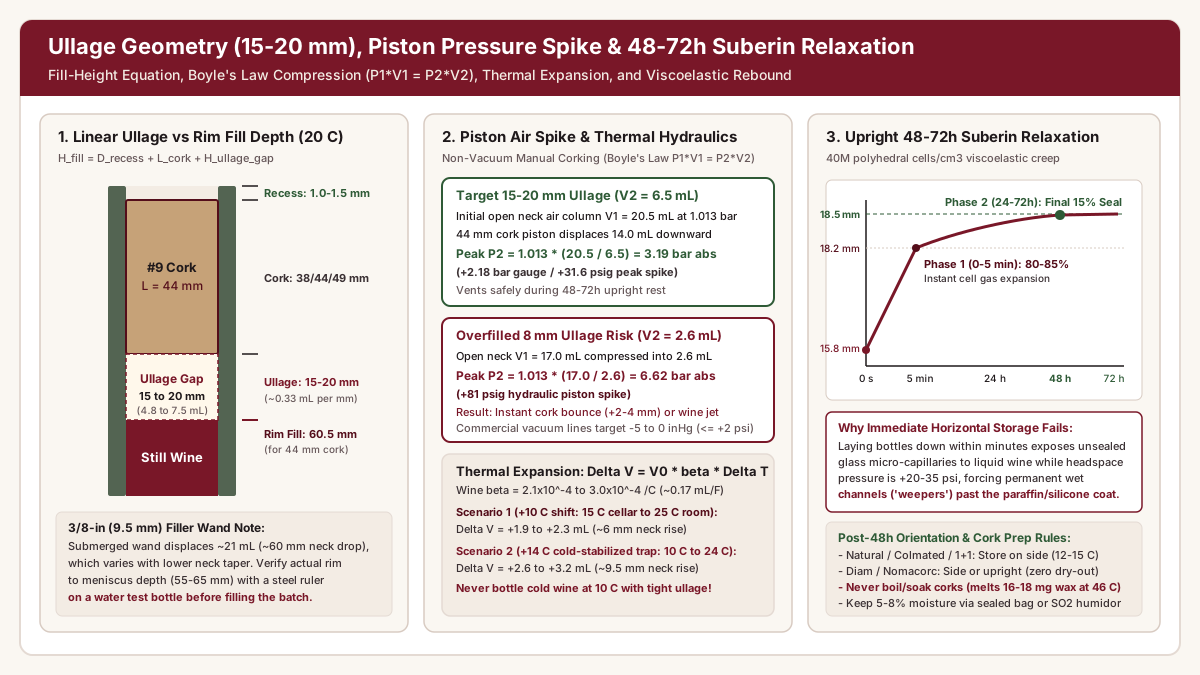
Linear ullage gap vs rim-to-meniscus fill depth
Winemaking references measure fill level in two ways that must not be confused:
- Linear Ullage (Headspace Gap,
H_ullage_gap): Measured from the bottom face of the inserted cork down to the liquid meniscus. For manual small-batch corking without vacuum, target15 mm to 20 mm(0.60 to 0.79 in) at20 °C (68 °F). (AWRI notes a commercial minimum of>12 mm to 13 mmat20 °Con vacuum-corked lines, while small-batch manual corking requires15 mm to 20 mmto absorb trapped piston air). - Rim-to-Meniscus Fill Depth (
H_fill_from_rim): Measured with a stainless steel ruler from the top glass finish rim down to the liquid surface before corking. As Scott Laboratories explains in its ullage calculation guide, rim fill depth is the sum of cork recess depth (D_recess), cork length (L_cork), and target linear ullage (H_ullage_gap):
H_fill_from_rim = D_recess + L_cork + H_ullage_gap
- Worked Example (Standard
44 mm#9Cork): With a target recess ofD_recess = 1.5 mm, a cork length ofL_cork = 44.0 mm, and a linear ullage gap ofH_ullage_gap = 15.0 mmto20.0 mm:H_fill_from_rim = 1.5 mm + 44.0 mm + 15.0 mm = 60.5 mm(up to65.5 mmfor a20.0 mmullage gap). If you upgrade from a38 mmcork to a49 mmcork without lowering your fill level by11 mm, the longer cork invades11 mmof headspace, shrinking a16 mmullage down to5 mmand guaranteeing hydraulic ejection.
In the ullage zone (45 mm to 65 mm below the rim) of a standard 750 mL Bordeaux bottle, the internal diameter averages 20.0 mm to 21.0 mm, yielding a cross-sectional area A = pi * r^2 = 3.14 cm^2 to 3.46 cm^2 (0.314 mL to 0.346 mL per millimeter of neck height). Thus, a 15 mm linear ullage holds 4.8 mL to 5.5 mL of gas, and a 20 mm linear ullage holds 6.5 mL to 7.5 mL.
Boyle’s Law piston pressure spike during non-vacuum corking
When a pre-compressed 16.0 mm cork enters an 18.5 mm neck without a commercial vacuum assist, its outer bark expands against the upper glass finish within the first few millimeters of travel, sealing the neck like a solid syringe piston. As the plunger drives the 44 mm cork the remaining distance down to 1.5 mm below the rim, it compresses the entire open column of air trapped above the wine (V_1) into the final 15 mm to 20 mm ullage space (V_2). Under Boyle’s Law for isothermal gas compression (P_1 * V_1 = P_2 * V_2):
P_2 = P_1 * (V_1 / V_2)
- Scenario A - Correct
18 mmUllage (V_2 = 6.5 mL): Before insertion, the63.5 mmopen neck column above the meniscus holdsV_1 = 20.5 mLof air at atmospheric pressure (P_1 = 1.013 bar abs/14.7 psia/0 psig). A44 mmcork displaces14.0 mLas it descends, compressing the trapped air intoV_2 = 6.5 mL:P_2 = 1.013 bar * (20.5 mL / 6.5 mL) = 3.19 bar absolute(+2.18 bar gaugeor+31.6 psig). This+22 to +36 psigtransient pressure cushion explains why WineMaker Magazine (2018) notes that every manually corked bottle begins life slightly pressurized, and why standing bottles upright for48 to 72 hoursis mandatory so that excess gas can vent slowly along the settling cork-glass interface or dissolve into the wine. - Scenario B - Overfilled
8 mmUllage (V_2 = 2.6 mL): If a bottle is overfilled so only8 mmof gas space (2.6 mL) remains below a44 mmcork (V_1 = 16.6 mL):P_2 = 1.013 bar * (16.6 mL / 2.6 mL) = 6.47 bar absolute(+79.2 psig). That+79 psighydraulic pneumatic spike instantly forces the cork2 mm to 4 mmback up out of the neck (“cork bounce”) the moment the plunger lifts, or jets liquid wine past the cork sides. By comparison, commercial vacuum corkers evacuate the neck prior to jaw release so post-corking internal pressure sits at-5 to 0 inHgvacuum or<= +2.0 psigat20 °C(UC Davis Bottling Line Readiness, 2019).
Volumetric thermal expansion math (Delta_V) and the cold-stabilization trap
Liquid wine is virtually incompressible. When a sealed bottle warms, the hydroalcoholic liquid (11% to 14% ABV, volumetric thermal expansion coefficient beta = 2.1 x 10^-4 to 3.0 x 10^-4 per °C, or roughly 0.16 to 0.18 mL per °F in a 750 mL bottle) expands into the neck according to:
Delta_V = V_0 * beta * Delta_T
- Moderate Cellar-to-Room Shift (
+10 °C: bottled at15 °C / 59 °F, stored or transported at25 °C / 77 °F):Delta_V = 750 mL * (2.5 x 10^-4 to 3.0 x 10^-4 /°C) * 10 °C = +1.88 mL to +2.25 mLliquid expansion (~6 mmlinear rise in the neck). In a bottle with18 mmullage (6.5 mL),+2.0 mLexpansion leaves4.5 mLof gas space and raises internal pressure by only~6 to 8 psi. In an overfilled bottle with8 mmullage (2.6 mL),+2.0 mLconsumes77%of the gas space, driving pressure past45 to 60 psiand pushing the cork out. - Cold-Stabilized Bottling Trap (
+14 °C: bottled cold at10 °C / 50 °F, warmed to24 °C / 75 °F): If you bottle a white wine straight out of cold stabilization at10 °C(see our home cold stabilization treatment and tests guide) with a tight12 mmullage (4.0 mL), warming to24 °Cexpands the wine byDelta_V = +2.6 mL to +3.2 mL(~9.5 mmneck rise). Nearly the entire headspace disappears, forcing wine past the cork seal. Always allow cold-stabilized wine to warm to15 °C to 20 °C (59 °F to 68 °F)before filling, or add8 mm to 10 mmof extra linear ullage during cold filling.
Also verify before bottling that dissolved carbon dioxide and malic acid are within still-wine limits using our pre-bottling degassing checks and malolactic fermentation completion tests, as excess dissolved CO2 (>1,400 mg/L saturation at 20 °C) compounds thermal headspace pressure.
Calibrating a 3/8-inch spring-tipped filler wand
As the Connecticut Agricultural Experiment Station guide and WineMaker Magazine describe, a standard 3/8-inch (9.5 mm outer diameter) spring-tipped plastic bottling wand submerged to the bottom of a 300 mm tall 750 mL bottle displaces approximately 21 mL of liquid. When you fill to the top glass rim and withdraw the wand, the meniscus drops by 21 mL, which equals roughly 58 mm to 63 mm below the rim in a standard Bordeaux neck (14 mm to 18 mm ullage under a 44 mm cork). However, in wider bell-necked Burgundy bottles or when using 49 mm corks, a 21 mL wand displacement may leave only 10 mm to 12 mm of clearance. Always fill one test bottle with water at 20 °C, withdraw the wand, measure the distance from the top rim to the meniscus with a stainless steel ruler, and verify that H_fill_from_rim - L_cork - 1.5 mm >= 15 mm.
How should you prepare corks, set insertion depth, and manage the 48-hour upright recovery?
Target insertion depth: 1.0 mm to 1.5 mm recess below the rim
Adjust the dual locking hex nuts on your floor corker’s plunger rod on an empty or water-filled test bottle before starting your batch so the top face of the cork seats 1.0 mm to 1.5 mm (1/32 to 1/16 in) recessed below the top glass finish rim (AWRI and Diam Bouchage specifications):
- Shallow insertion (protruding
>0 mmabove the rim): Tears PVC heat-shrink or spun polylaminate/tin capsules, prevents bottles from standing flat in inverted cardboard cases, and leaves the top2 mm to 3 mmof the cork uncompressed outside the18.5 mmbore. - Over-insertion (
>2.0 mm to 3.0 mmdeep below the rim): Steals2 mm to 3 mmdirectly from your15 mm to 20 mmheadspace gap, spikes piston insertion pressure, creates a recessed cup on top of the neck that traps rinse water (promoting mold growth underneath the capsule), and reduces corkscrew purchase.
Pre-bottling cork preparation: preserving the 16 to 18 mg paraffin/silicone coating
Reputable winemaking corks ship in sulfur-dioxide-flushed polyethylene bags calibrated to 5% to 8% moisture content (6% +/- 2% target) and tumbled with 16 mg to 18 mg of food-grade paraffin wax and silicone elastomer per stopper. This microscopic hydrophobic coating lubricates the cork during 16 mm jaw insertion, seals micro-capillaries between the bark and glass, and ensures smooth corkscrew extraction years later.
Never boil corks or soak them for hours in water or sanitizer. Boiling (100 °C / 212 °F) or hot soaking causes three irreversible failures:
- Melts and strips the surface lubricant: Paraffin wax softens and melts between
46 °C and 68 °C (115 °F to 154 °F). Hot water strips the paraffin/silicone coat off the bark, leaving waxy droplets suspended in the wine and causing corks to bind and tear in half during extraction. - Waterlogs lenticels and causes plastic shear: Prolonged soaking drives water (
>10% to 12%moisture) into the outer lenticels. When squeezed to15.8 mmin corker jaws, waterlogged tissue shears plastically rather than rebounding elastically, and dirty soak liquid is wrung directly into the bottle neck. - Hydrolyzes agglomerate adhesives: In technical (
1+1) and micro-agglomerated corks, boiling water degrades the food-grade polyurethane resin binding the cork granules.
Use one of three sanctioned cellar preparation methods depending on bag condition:
- Method 1 - Direct from a Fresh Factory-Sealed Bag (Preferred by AWRI & Diam Bouchage): Squeeze a sample cork between your thumb and forefinger; if it compresses slightly (
5% to 8%moisture) and cannot be snapped in half by hand, load the corks dry straight from the sealed factory bag into a sanitized corker hopper. - Method 2 - Sulfite Vapor Humidor Bucket (Best for previously opened bags): Place dry corks inside a clean plastic colander or strainer suspended above (never touching)
1 inchof1%potassium metabisulfite (KMBS) solution inside a lidded food-grade bucket for2 to 4 hoursbefore bottling. GaseousSO2sanitizes the bark surface and gently raises cork moisture to6% to 7%without wetting or stripping the silicone/paraffin coating. - Method 3 - Brief Cold Sulfite Mist or Rinse (WineMaker Magazine / Pambianchi fallback): Spray corks lightly with a spray bottle of room-temperature (
20 °C) sulfite sanitizing solution (50 to 100 mg/LfreeSO2), shake off excess droplets in a sanitized colander, and insert immediately.
Why the 48 to 72 hour upright rest is mandatory before horizontal storage
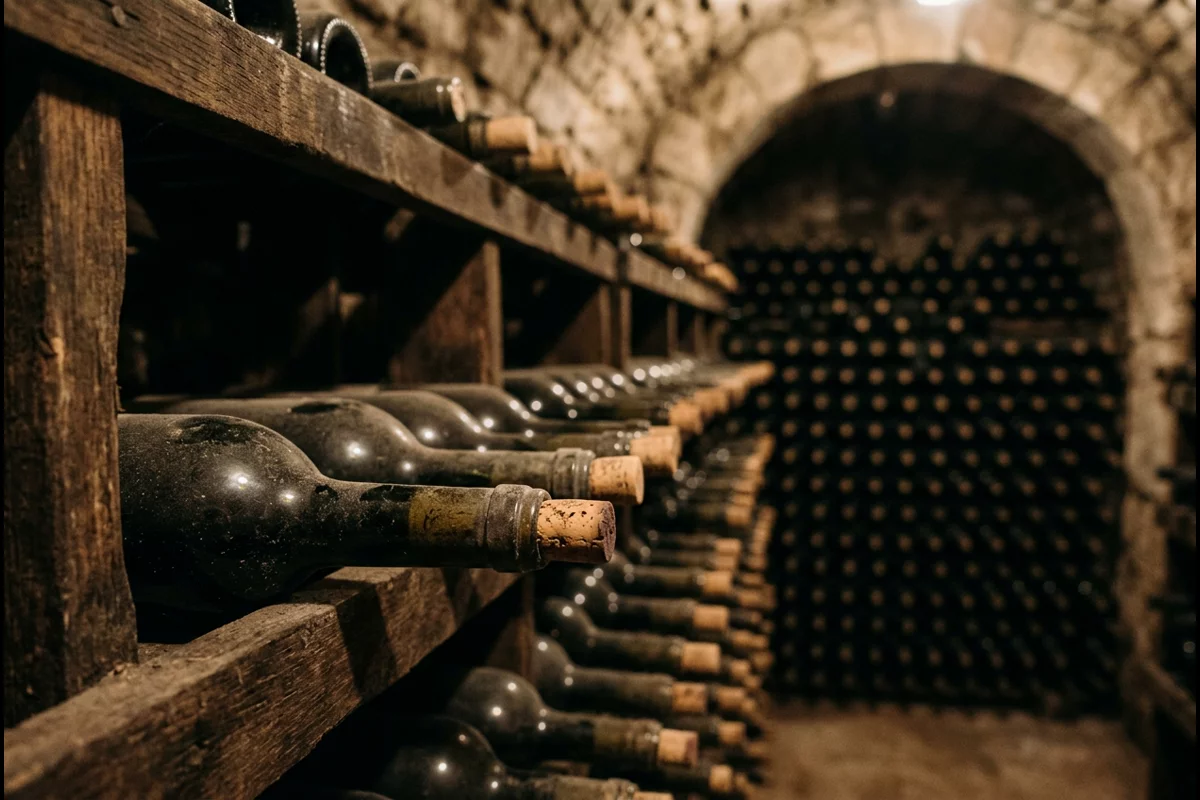
When a cork exits 15.5 mm to 16.0 mm floor corker jaws into an 18.5 mm bottle neck, suberin cellular recovery occurs in two distinct viscoelastic stages:
- Phase 1 - Instantaneous Elastic Gas Rebound (
0 to 5 minutes,80% to 85%recovery): Compressed air trapped inside the 40 million intact polyhedral cells per cubic centimeter expands immediately, pushing the cork diameter from15.8 mmout to~18.2 mm to 18.4 mmto establish initial friction against the glass wall. - Phase 2 - Delayed Viscoelastic Cell-Wall Relaxation (
24 to 72 hours, final14% to 15%seal): The buckled, corrugated suberin and lignin cell walls slowly unbend via viscoelastic creep relaxation, building full radial normal pressure into the microscopic surface irregularities of the glass bore while the+22 to +36 psigpiston headspace pressure vents or equilibrates.
If you lay a freshly corked bottle on its side within minutes of corking, liquid wine floods the cork-glass interface while internal gas pressure is still +20 to +35 psig and delayed viscoelastic creep has not yet sealed the microscopic axial capillaries along the bore. The pressurized headspace acts as a pneumatic piston, forcing liquid wine along those unsealed micro-channels, stripping the paraffin film, and establishing permanent wet tracks (“weepers”) that continue to seep even after 72 hours.
Wait 48 to 72 hours with bottles standing upright at 15 °C to 20 °C, inspect the necks for clean dry seals, apply capsules only after the top rim is completely dry, and then rack bottles sealed with natural, colmated, or 1+1 technical corks on their sides at 12 °C to 15 °C (54 °F to 59 °F) and 60% to 75% relative humidity. Bottles sealed with co-extruded synthetic closures (Nomacorc) or Diam micro-agglomerated corks do not require liquid contact to prevent drying and may be stored either upright or horizontally.
Diagnostic troubleshooting matrix and pre-corking verification checklist
Use the troubleshooting table below to diagnose mechanical corking defects during your test-bottle run, and record your setup parameters in the verification checklist before filling the batch (personal-use batches remain subject to the 100/200 gallon federal ceiling detailed in our six-step home winemaking guide).
| Observed Defect | Primary Mechanical or Hydraulic Cause | Corrective Action on the Bottling Setup |
|---|---|---|
Cork sits proud 2 to 4 mm above rim right after insertion (“Cork Bounce”) |
Plunger depth stop nut set too high, OR overfilled bottle (<10 mm ullage) generating >60 psig piston air cushion |
Verify rim fill depth is 60.5 to 65.5 mm (15-20 mm ullage); thread plunger stop nut down 1.5 to 2 turns; hold lever down 1-2 seconds at bottom of stroke |
| Vertical fold or score line down side of cork (“Wormhole” leak) | Inserting a 24 mm (#9) or synthetic cork with a conical hand corker, OR burred/misaligned nylon iris jaws on a floor corker |
Switch to a 4-jaw floor corker (15.5-16.0 mm pre-compression); inspect iris blocks at half-stroke for burrs or stepped alignment |
| Plunger pin gouges or punches into top center of cork | Brittle dry corks (<4%-5% moisture), boiled/waterlogged spongy corks, or narrow hand-corker plunger used on 49 mm / stiff synthetic corks |
Test cork pliability by hand; condition dry corks in an SO2 vapor humidor bucket for 2-4 hours; use a wide-face floor corker plunger |
| Wine weeping past cork days or weeks after bottling | Bottles laid horizontally before 48-72h upright rest; wine bottled cold (<12 °C) with tight ullage and warmed; or refermentation (>1.0 g/L RS / incomplete MLF) |
Stand bottles upright 48-72 hours; warm cold-stabilized wine to 15-20 °C before filling; verify dryness and MLF completion (<=0.3 g/L malic acid) |
| Bark ring sheared off bottom edge of cork on glass rim | Corker throat not centered over bottle mouth, chipped bottle finish, or conical hand corker exit (17.8 mm) catching a narrow 18.0 mm bore |
Adjust spring footplate centering guide; inspect every glass rim for chips; use an iris floor corker with 2.5 to 3.0 mm radial clearance |
Pre-corking field measurement and calibration checklist
- Bore & Bottle Style Check: Measure
3sample bottles from your case at the mouth with internal calipers (18.0 mm to 19.0 mmstandard CETIE bore) and note whether necks are parallel-walled (Bordeaux) or sloped/bell-tapered below45 mm(Burgundy). - Cork Size & Moisture Check: Confirm
#9(24 mm x 44 mmor49 mm) or#8(22 mm x 38 mm) diameter matches your bore and aging target; verify corks are pliable (5% to 8%moisture) and dry or conditioned viaSO2vapor humidor (never boiled or soaked). - Wine Temperature & Stability Check: Measure bulk wine temperature in the bottling vessel (
15 °C to 20 °C/59 °F to 68 °Ftarget) and confirm specific gravity stability, malolactic completion, and freeSO2adjustment. - Water Test-Bottle Fill Calibration: Fill one test bottle with
20 °Cwater using your bottling wand, withdraw the wand, and measure rim-to-meniscus depth with a stainless steel ruler (60.5 mm to 65.5 mmfor a44 mmcork, leaving15 mm to 20 mmlinear ullage below the cork). - Iris Jaw & Plunger Recess Calibration: Close the empty floor corker handle halfway to verify smooth
15.5 mm to 16.0 mm4-jaw alignment, then cork the water test bottle and lock the plunger hex nuts so the top of the cork sits1.0 mm to 1.5 mmrecessed below the glass rim. - Upright Rest Schedule: Stand all corked bottles upright at
15 °C to 20 °Cfor48 to 72 hoursbefore applying capsules and transferring natural-corked bottles to horizontal cellar racks. Browse the Bottling category archive for additional filling, closure, and packaging specifications.