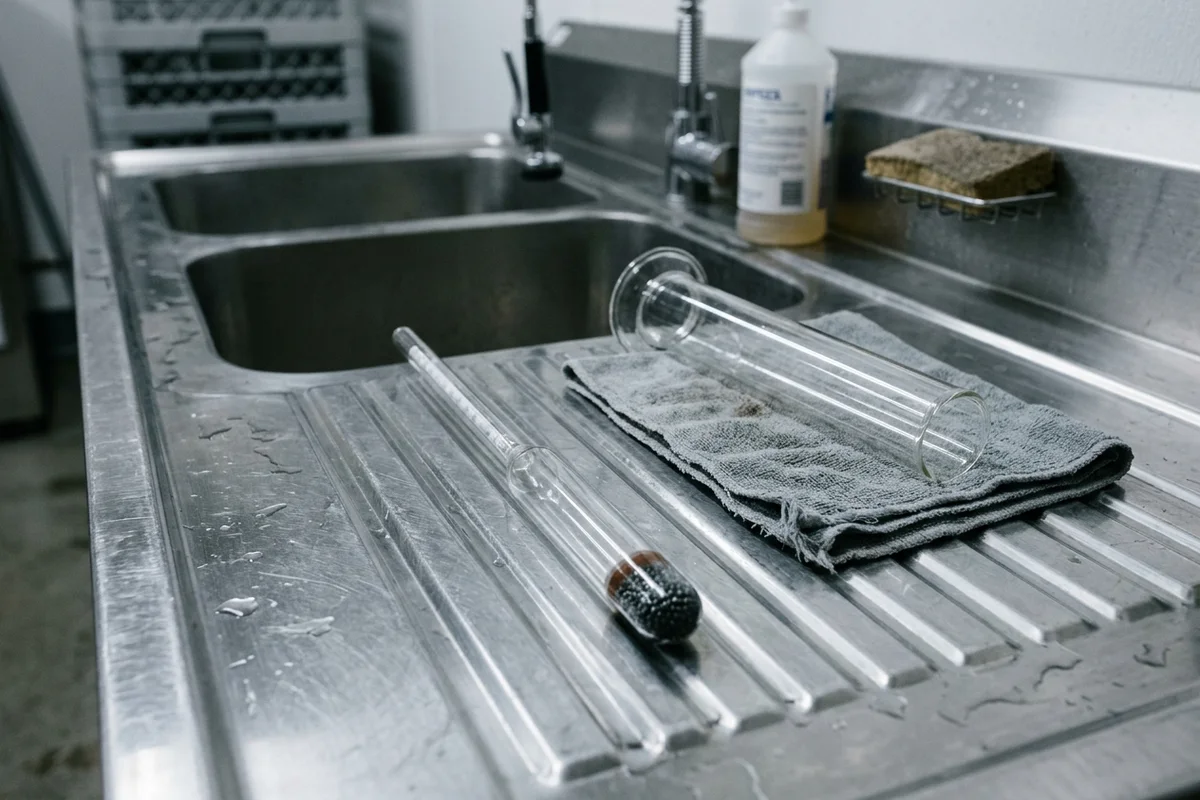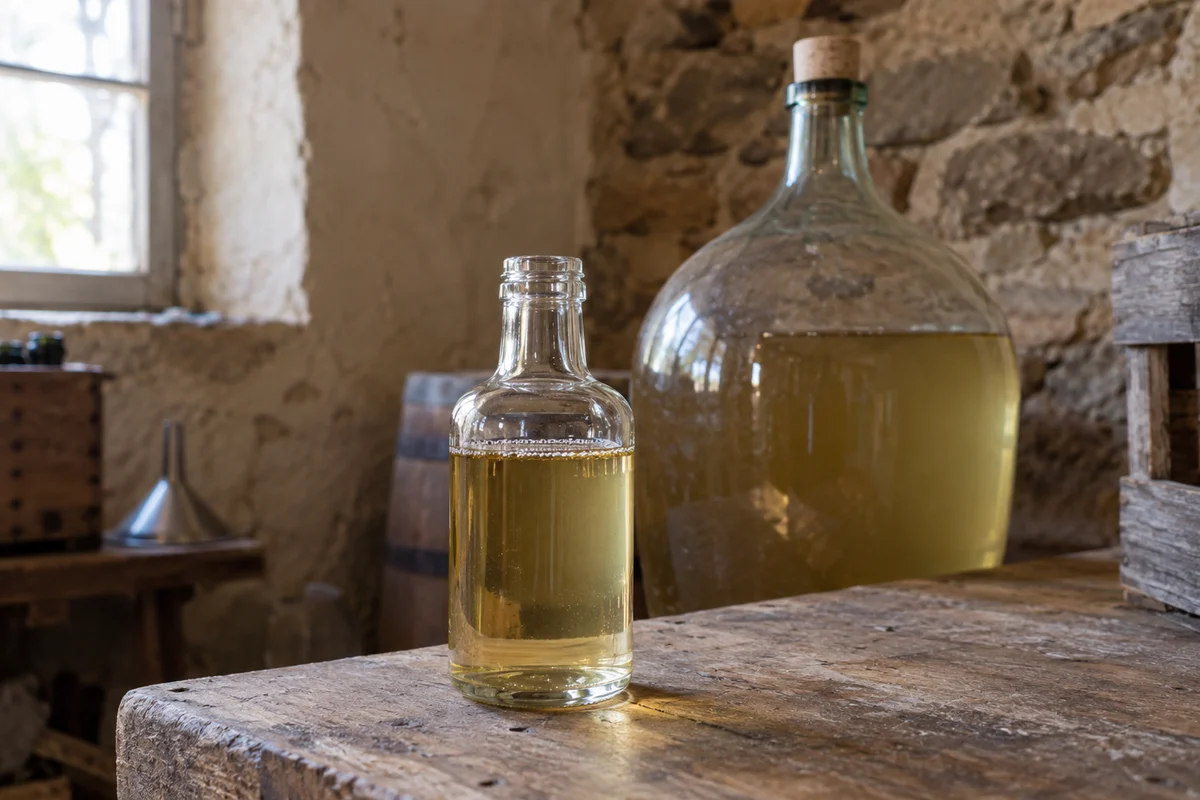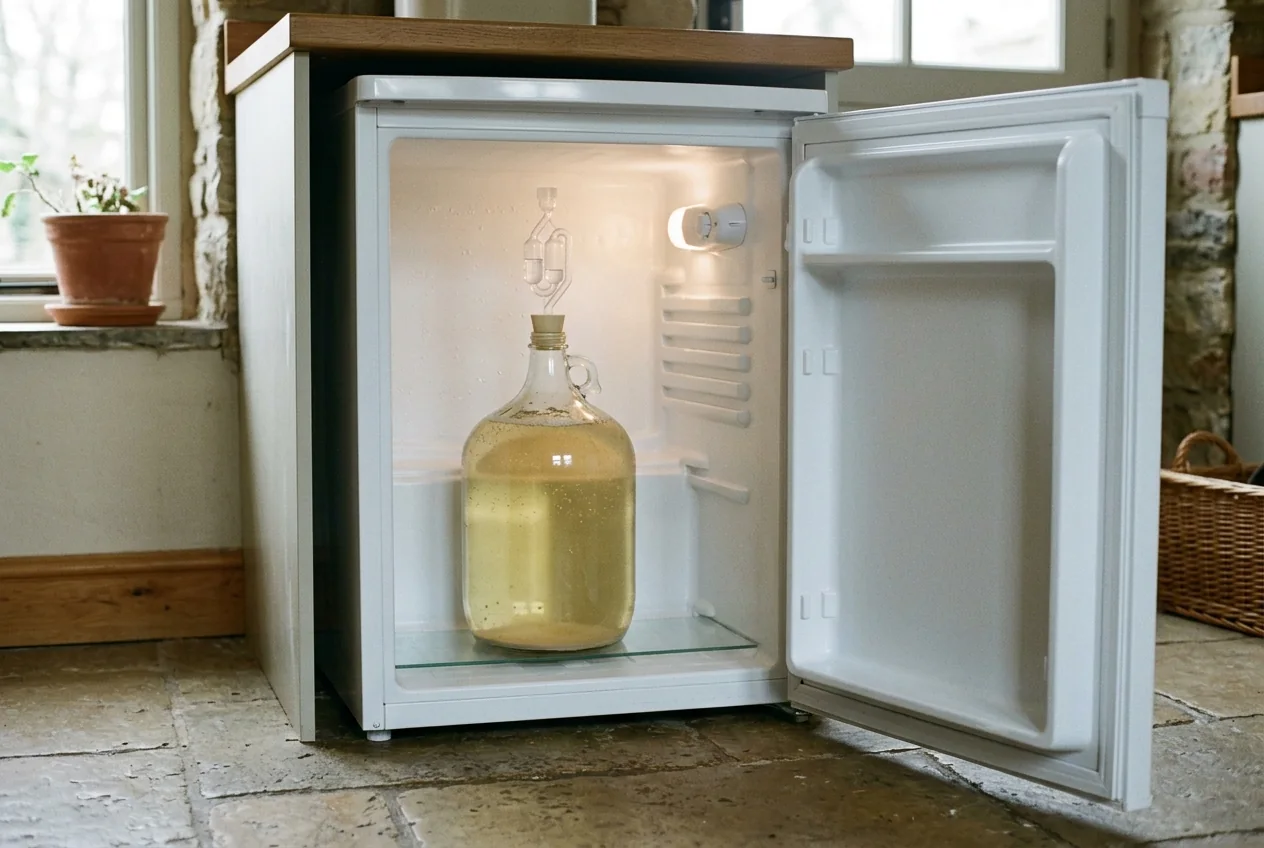
Racking too early, while coarse solids are still mixed through the wine, wastes the transfer and can pull that sediment into the next vessel. Wait until a coarse layer has settled and a measurement shows alcoholic fermentation is ending or has ended, then decide whether the finer lees stay. Wine type, fruit condition, the malolactic plan, and air exposure all change that decision.
Racking moves wine from one container to another so solid deposits stay behind (OIV International Code of Oenological Practices, II.3.2.3). The first rack after primary fermentation is that transfer. A second carboy is a container. Malolactic fermentation is bacteria converting malic acid, and Bruce Zoecklein (Virginia Tech, 5 March 2003, citing Delteil, 2000) places it on the fine lees left after the coarse lees come off. His 1 August 2003 note calls heavy lees the fraction that settles in the first 24 hours, and light lees what settles later, kept by variety, fruit condition, and style. Those 24 hours belong to the short-vatted wines in that note, not to every home batch. A sulfur smell means have the wine tested or ask someone qualified. A picture of the sediment does not show the wine is sound, and this page sets no sulfur dioxide dose.
This page uses the OIV racking section and two Virginia Tech Enology Notes, read from the saved texts on 12 October 2026. Forum threads are not used as process evidence. The page is a decision aid for a small batch. It is not a cellar log from any winery, and the photographs are illustrations.
Key points:
- Name the job. Moving wine into a second vessel is a transfer. Malolactic fermentation is a later or overlapping bacterial step.
- Split the sediment. Heavy (gross) lees and light (fine) lees are different fractions in Zoecklein’s 2003 notes.
- Pick an oxygen purpose. The OIV code treats a closed transfer and a deliberate aeration as different racking purposes.
- Write the batch down. The decision table and the blank record below are the working tools. They contain no sample reading.
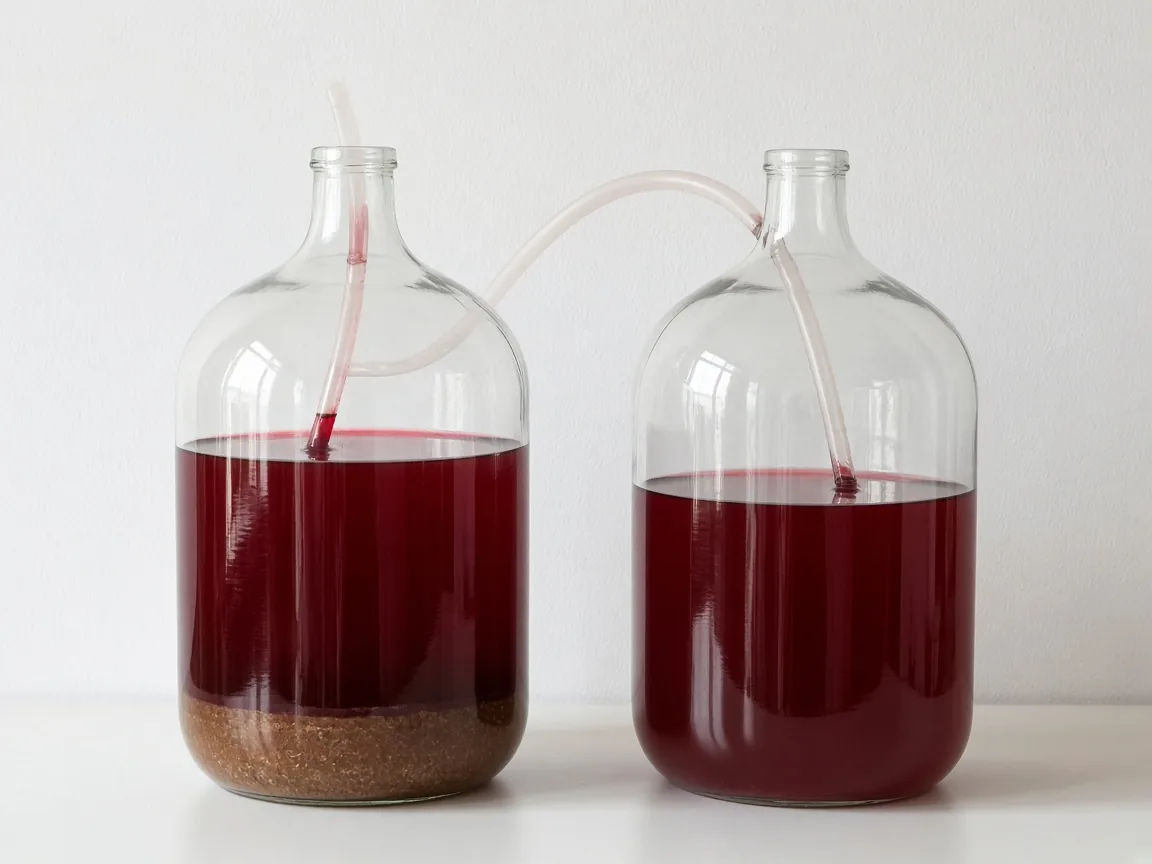
Illustration. Sediment stays in the first vessel while wine moves into a second one. The hose position is not a measured inlet depth, and this is not a batch from this site.
What is the first rack after primary fermentation?
The first rack is a transfer that leaves deposits behind once alcoholic fermentation is ending or has ended. The OIV code (II.3.2.3) defines racking as moving wine from one wine container to another so solid deposits separate from the liquid. Its stated objectives include separating the wine from the lees, and separating it from microorganisms at the end of the alcoholic fermentation, the malolactic fermentation, or both.
Home notes often call the destination vessel a secondary fermenter. In that usage the yeast may still be finishing sugar under an airlock. The new glass does not start malolactic fermentation. Lactic acid bacteria do that, when you inoculate them or when they are already in the wine. The fermentation guide holds the checks for a finished alcoholic fermentation and explains the bacterial step. This page does not add a gravity cutoff or a day count.
The same OIV section also lists later reasons to rack: deposits from clarifying agents, ordinary cellar moves, and tartrate crystals after a cold stabilization. Those are other transfers. They are outside the first rack after primary fermentation. How many times to rack before bottling is already answered in the home winemaking guide. Clarifying and topping up sit in step 5 of that guide.
How do gross lees differ from fine lees?
Gross lees are the coarse fraction that settles first. Fine lees are the lighter fraction that keeps settling after that coarse layer is gone. Zoecklein gives working definitions in two 2003 notes to regional producers, and the wording is not identical.
| Fraction | Enology Notes #78, 1 August 2003 | Enology Notes #71, 5 March 2003 | What he says to do with it |
|---|---|---|---|
| Heavy lees (gross) | Material that precipitates in the 24 hours immediately after fermentation | The fraction removed by a rack 24 hours after yeast fermentation, so that light lees are what remain | Remove them. In the August note this sits in a discussion of enzyme use, extraction, and short vatting during a wet Virginia season |
| Light lees (fine) | Material that precipitates more than 24 hours after fermentation | Lees remaining after that 24-hour rack | Keep them or not according to variety, fruit condition, and wine style (August note, citing Delteil, 2001). The March note, citing Delteil (2000), wants malolactic fermentation run on light lees only |
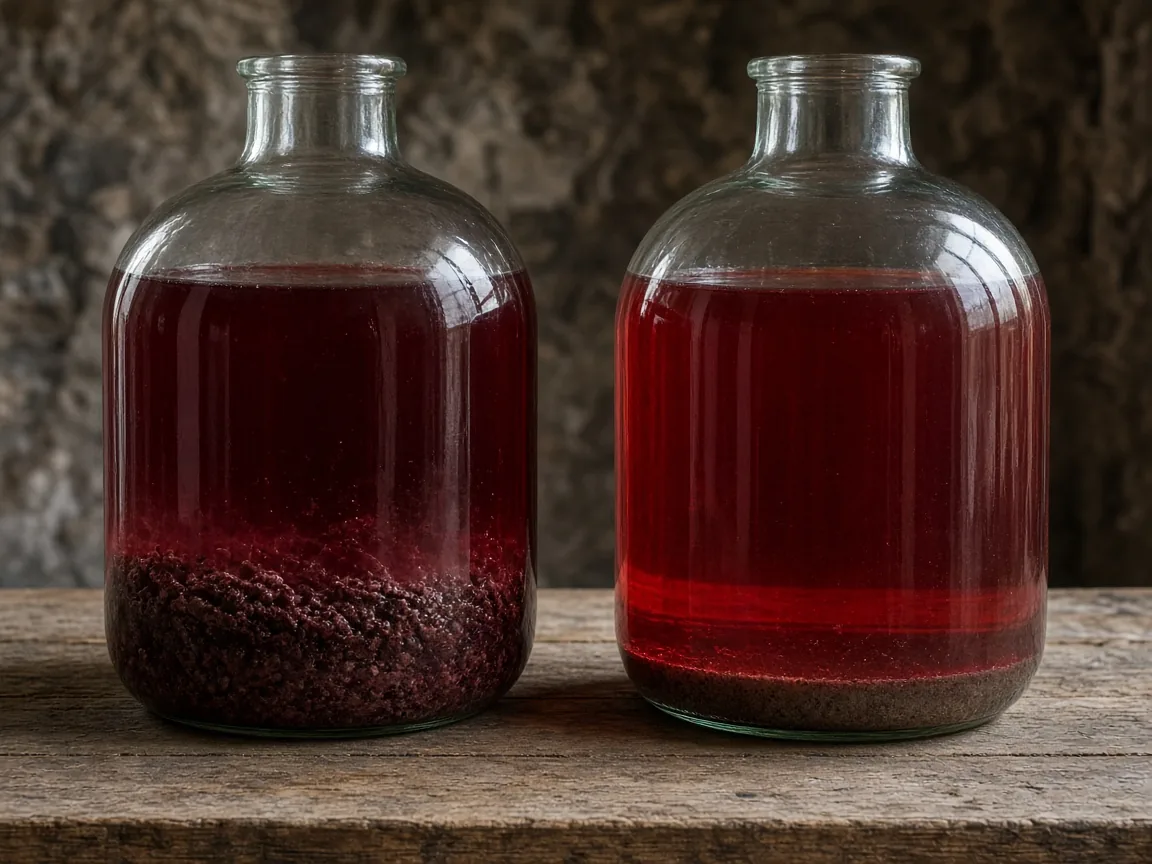
Illustration of a thick settled layer beside a thin film, the contrast named in Enology Notes #78. It is not a timer, not a diagnosis, and not wine from this site.
The August note then gets specific: after dejuicing, short-vatted wines should be racked off the heavy lees 24 hours after fermentation. That sentence is about those wines, in that season’s advice. A home batch of a different fruit year does not inherit the interval as a required schedule. Use the two names, watch what your own vessel actually drops, and write the time you observed.
How do wine type, fruit, and a malolactic plan change the first rack?
Match the rack to the wine in the vessel, the condition of the fruit, and whether malolactic fermentation is part of the plan. A red and a white do not share one clock, and a planned malolactic fermentation changes which lees you want left in the wine.
For a red pressed before dryness, the August 2003 note is the relevant text, and only when you are doing that short vatting. Zoecklein wrote it for a wet Virginia season with uneven ripening and disease pressure. The aim he describes is selective extraction, then removal of the heavy lees. He adds that micro-oxygenation or splash racking may help the tannins afterward, depending on the variety and on how far polymerization has already gone. That is a conditional remark about those short-vatted wines. It is not a default splash for every red.
For a white wine whose style stays on lees, the March 2003 note quotes Lavigne-Cruege and Dubourdieu (2001): great white wines, in their statement, come from a prolonged period on the lees. The same note names the main risk of lees storage as reductive defects such as hydrogen sulfide and mercaptans. When yeast cells are compacted and oxygen is low, Zoecklein says the chance of those off sulfur compounds goes up, which is why he writes that most producers do not run sur lie storage in large stainless steel tanks. He also says that aerating a wine and taking it fully off the lees may leave a reductive defect in place, and that the wine then has a higher risk of oxidative degradation. In the barrel comparison he summarizes, the lot with the greatest effect had its lees separated, stirred often, and returned after 48 hours. That lot was one wine that already had the defect. Forty-eight hours is that study’s interval, not a carboy schedule.
If malolactic fermentation is planned, the March note is the one to use. Zoecklein, citing Delteil (2000), says the fermentation should run on light lees only, meaning after the heavy fraction has been racked off. He also writes that temperatures lower than 15 °C delay malolactic fermentation, and that a shorter completion, in his view, brings sensory benefits and a lower risk of Brettanomyces, Lactobacillus, and Pediococcus. Those statements are his prelude to a 2003 technical meeting. They are not a temperature setting or a microbial clearance for your batch. Test malic acid if that step is part of the plan. The fermentation guide explains the test. This page does not choose the bacteria, and it does not set a sulfur dioxide addition. Zoecklein lists sulfur dioxide concentration and the timing of post-fermentation additions among the factors in the papers he cites. The figures stay in those papers.
When should the transfer keep air out, and when is aeration a different job?
Choose one purpose and write it down. In OIV II.3.2.3 the two air options are different prescriptions.
A transfer whose purpose is to avoid oxidation is done in the absence of air. For that case the code says the container being filled must be rendered inert with carbon dioxide, nitrogen, or argon, and those gases must comply with the International Oenological Codex. If you cannot do that, you have not performed the air-free rack the code describes. Say so on the record. This page does not turn that prescription into a shopping list for gas fittings.
A transfer whose purpose is to eliminate hydrogen sulfide, to reduce carbon dioxide, or to create a controlled oxidation is done with aeration. The code lists that as its own prescription. A splash you did not plan is still air in the wine. Record it as unplanned rather than as a treatment.

Illustration of a quiet fill beside a fill that breaks the surface, the two air purposes in OIV II.3.2.3. No gas blanket is shown, and no measurement is shown.
A smell of hydrogen sulfide sits between those two prescriptions and the March 2003 note. The OIV code names elimination of hydrogen sulfide as one reason to aerate. Zoecklein, summarizing the 2001 barrel lots, says aeration plus total lees removal may not clear a reductive defect, and that the wine without its lees is more exposed to oxidation. Hold both statements. They do not collapse into one thing you do at the carboy. The smell is a prompt to have the wine tested, or to ask someone qualified. Looking at the sediment, or at a photograph of it, does not show whether the wine is sound. This page gives no sulfur dioxide dose.
Which row of the first-rack decision table fits this batch?
Use the row that matches the wine, the fruit, and the measurement you actually have. Empty-sounding cells mean the item is still yours to test. No row is a day count.
| Wine type | Fruit and solids | Fermentation measurement | Lees type | MLF plan | Oxygen control | Items still to test |
|---|---|---|---|---|---|---|
| Any wine a home note has just moved toward a second vessel | Skins, pulp, or juice still in the first vessel | A reading that is still falling. The fermentation guide holds the checks. This row has no target number | Coarse fruit solids and yeast may both be present. Write what has settled and what is still cloudy | The new vessel does not start malolactic fermentation. Bacteria do, and only if that step is underway or planned | Closed, deliberately aerated, or an unplanned splash. Write which one happened | Whether alcoholic fermentation is still moving, and whether you want malolactic fermentation at all |
| Red wine pressed before dryness (short vatting) | Use this row for fruit in the situation of the 1 August 2003 note: uneven ripeness, a wet season, disease pressure. A red color alone does not put you here | Alcoholic fermentation just finished. The note’s 24 hours apply to those short-vatted wines after dejuicing | Heavy lees: the fraction that settles in the first 24 hours, in that note’s definition. Remove them | If malolactic fermentation is planned, the 5 March 2003 note, citing Delteil (2000), wants it on light lees only | Splash racking is a later, conditional remark about tannins, variety, and polymerization. It is not the default | Confirm the alcoholic fermentation has finished. Test malic acid if malolactic fermentation is the plan. Do not copy 24 hours onto another fruit year |
| Red or white whose style keeps fine lees | Sound fruit, with the coarse solids already out. Retention still depends on variety, fruit condition, and style (1 August 2003, citing Delteil, 2001) | Alcoholic fermentation ending or finished. Write the instrument and the number you measured | Light lees: material that keeps settling after the heavy fraction is gone | A planned malolactic fermentation belongs with this fraction in the 5 March 2003 note | To avoid oxidation, OIV II.3.2.3 describes an air-free rack and an inerted receiving vessel (carbon dioxide, nitrogen, or argon meeting the International Oenological Codex) | Variety and style. Any sulfur smell, which is a prompt to test, not a verdict from the sediment |
| White wine kept on lees for a long period | The non-soluble solids you allowed into the fermenter. Zoecklein lists control of those solids among the factors in the papers he cites | Alcoholic fermentation finished, then a prolonged lees period. Lavigne-Cruege and Dubourdieu (2001), as he quotes them, say great white wines need that contact | Light lees kept on purpose. Heavy lees still come off first, using the 2003 definition | Decide malolactic fermentation from a malic-acid test. This page does not choose it | Compacted yeast and low oxygen raise the chance of off sulfur compounds. Zoecklein writes that most producers do not run sur lie storage in large stainless tanks | Vessel size, and whether a reductive smell has appeared. Sulfur dioxide additions are outside this page |
| Any wine that already smells of hydrogen sulfide or a related sulfur fault | Whatever the fruit was. The smell outranks the look of the sediment | Record the reading you have, then stop treating the smell as something the sediment explains | Full lees removal is not automatically the fix. In the barrel lots summarized from the 2001 paper, the strongest result was temporary removal, frequent stirring, and return after 48 hours, on a wine that already had the defect | Malolactic status stays unknown until malic acid is tested | OIV lists aeration as a separate purpose: hydrogen sulfide, carbon dioxide, or a controlled oxidation. That purpose is different from racking without air | A laboratory test, or a question to someone qualified. A photograph of the sediment does not clear the wine. No sulfur dioxide dose is given here |
What goes on the racking record?
Copy the left column into your own notes and fill the right column from this batch. The right column is blank here because this page has no batch, no hydrometer reading, and no laboratory result.
| Field | This batch |
|---|---|
| Date and time | |
| Batch name in your own notes | |
| Vessel you left, and vessel you filled | |
| Wine type | |
| Fruit condition, and which solids were in the first vessel | |
| Instrument, the number you measured, and whether it is still falling | |
| Lees removed, and lees kept (gross, fine, or not yet named) | |
| Malolactic plan: planned, not planned, or not tested | |
| Air: closed transfer, deliberate aeration, or an unplanned splash. Gas used, if any | |
| Any smell, and the test or person you will ask | |
| Items still untested |
When the wine is later clear and stable, bottling is a different job. The sequence, fill, and closure are in how to bottle wine.
When this does not apply
This page is the first rack tied to the end of alcoholic fermentation. It does not cover:
- A count of racks before bottling, which the home winemaking guide already answers.
- Clarifying, fining, or topping up, which are step 5 of that guide.
- The bottling steps themselves.
- A shopping list for hoses, pumps, or gas fittings.
- One number of days for every home wine. The 24-hour and 48-hour figures above stay inside the notes and the study that used them.
- A judgment of contamination from the look of the sediment, or from a photograph of it.
The two Virginia Tech notes are 2003 advice to regional producers, with a season and a wine type attached. The OIV text is an international practice code. Neither one is a United States home-winemaking statute.
Method and sources
The racking definition and the two air prescriptions are from OIV II.3.2.3, International Code of Oenological Practices, read 12 October 2026. The heavy-lees and light-lees definitions, the short-vatting context, and the conditional remark on splash racking are from Bruce Zoecklein, Enology Notes #78, 1 August 2003. The malolactic-on-light-lees statement, the lees-storage risks, the stainless-tank remark, and the summary of the Lavigne-Cruege and Dubourdieu (2001) barrel lots are from Enology Notes #71, 5 March 2003. Delteil is cited only as Zoecklein cites him. Reddit and other forum pages were demand signals, not process sources.
Other notes in this series are on the blog.