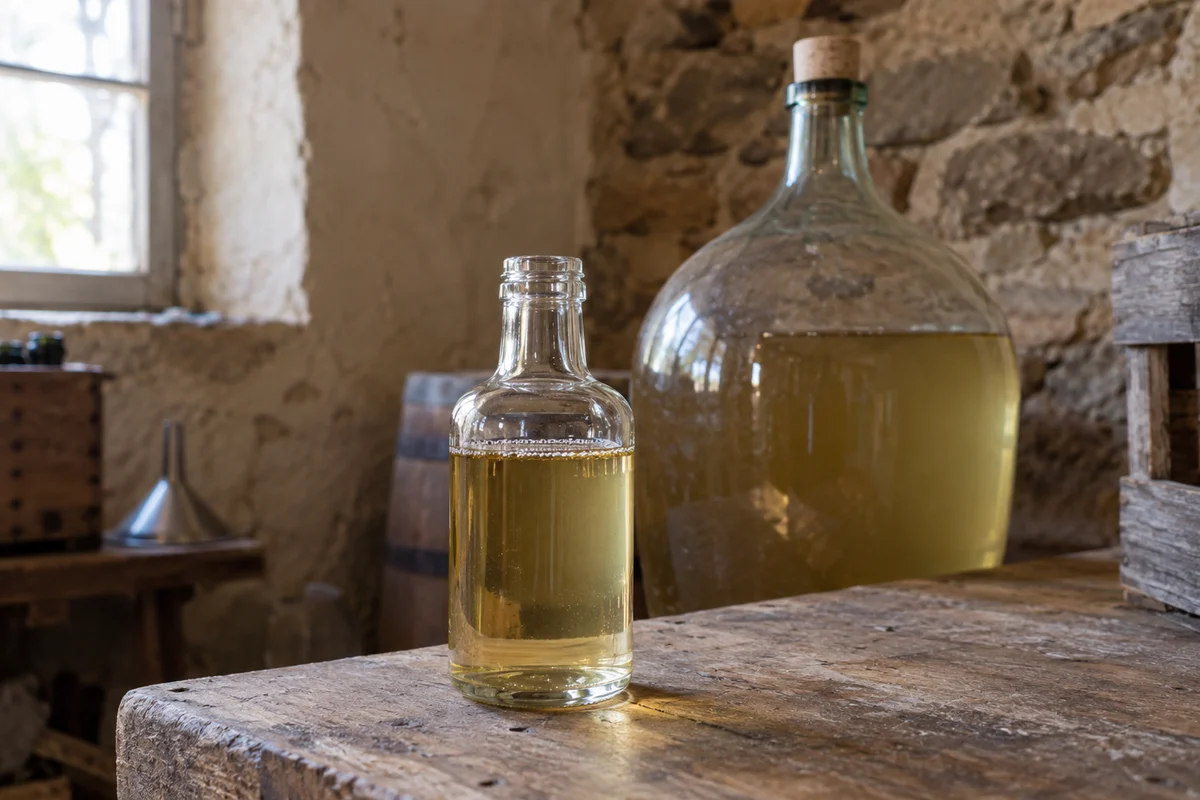
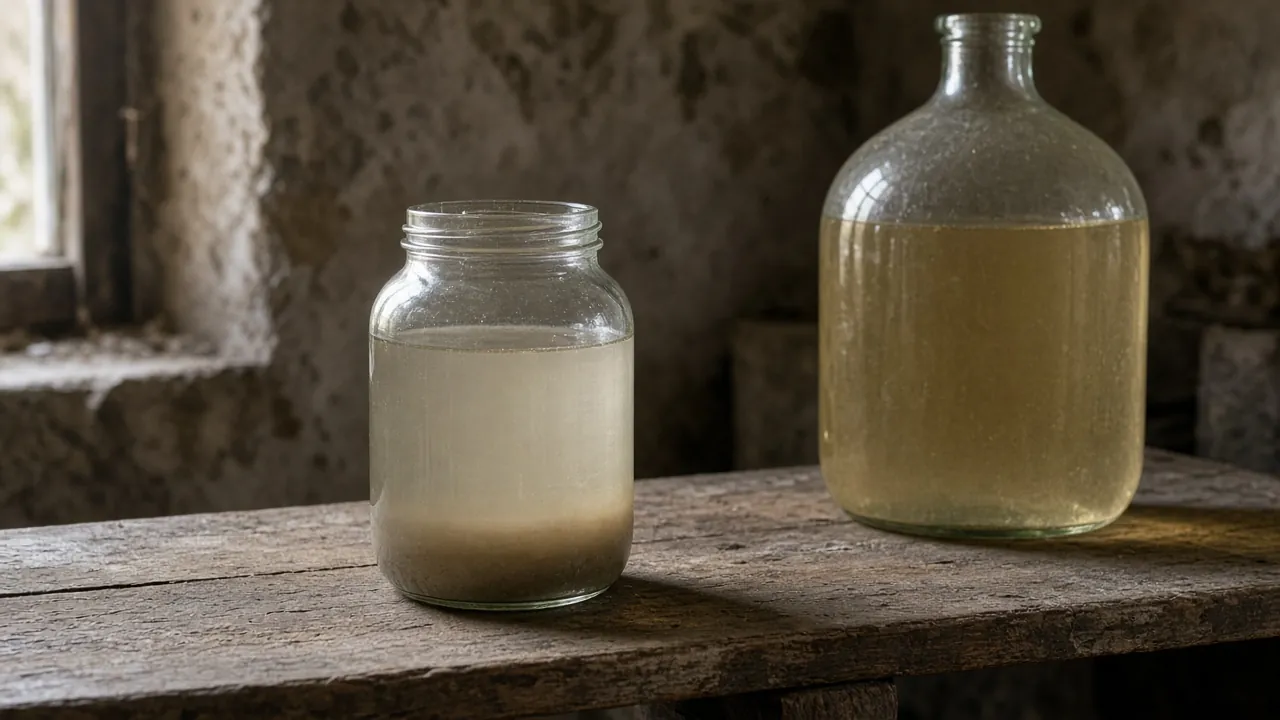
Floating a standard hydrometer or a spirit alcoholmeter in finished wine without an initial reading gives the wrong alcohol figure and fails to recover a missing starting gravity. When you have not taken starting hydrometer readings, you must choose a finished-wine test that matches the wine’s residual sugar and clarity or arrange a laboratory alcohol analysis.
A standard wine hydrometer calculates alcohol by volume (% ABV) only from the density drop between Original Gravity (OG) before yeast fermentation and Final Gravity (FG) afterward. Once fermentation finishes, a single hydrometer reading—often -1 to -2 °Brix in dry wine, according to WineMaker Magazine (July 2025)—reflects only the combined density of water, ethanol and remaining dissolved solids. For a clear, bone-dry, unsweetened wine, a glass capillary vinometer provides a rough cellar estimate, while an ebulliometer measures boiling-point depression in wines with about 2% (20 g/L) or less residual sugar to within roughly 0.5% alcohol, according to the Australian Wine Research Institute (AWRI). Sweetened, chaptalized or blended batches require paired density-and-refraction instruments or contract laboratory testing.
Use this decision table to match your batch records and wine condition to what can still be measured:
| Starting gravity & batch history | Sweetness, clarity & gas state | Usable instruments or paths | What can still be estimated or measured | What cannot be recovered | Lab request if exact ABV is needed |
|---|---|---|---|---|---|
| No OG recorded; fermented dry; no post-fermentation sugar, water or wine additions | Bone-dry, brilliant clarity, degassed | Capillary vinometer (cellar estimate); ebulliometer; paired refractometer + digital density meter; wine laboratory | Rough cellar ABV estimate (average of 3 vinometer readings per Brewbitz) or boiling-point / lab ABV | True starting specific gravity of the original must unless back-calculated by paired lab instruments | Alcohol (% v/v) by distillation/densitometry or NIR/MIR spectroscopy |
| No OG recorded; residual sugar up to about 2% (20 g/L) | Off-dry, clear, degassed | Ebulliometer; paired refractometer + digital density meter; mini-distillation + hydrometry; wine laboratory | Boiling-point alcohol within about 0.5% alcohol (AWRI; WineMaker Magazine), or direct distillate/lab ABV | Valid capillary vinometer reading (residual sugar invalidates capillary action) | Alcohol (% v/v) plus residual sugar (glucose + fructose) |
| No OG recorded; back-sweetened, stalled, or above about 2% residual sugar | Semi-sweet or sweet, or fermentation completion uncertain | Paired refractometer + digital density meter; distillation + hydrometry/densitometry; wine laboratory | Direct alcohol and sugar concentration via paired density/refraction or distillate measurement | Single-hydrometer ABV, vinometer reading, or uncorrected ebulliometer reading (sugar raises boiling point) | Alcohol (% v/v) by distillation/densitometry or calibrated NIR/MIR, plus glucose + fructose |
| No OG recorded; step-fed sugar, diluted with water, or topped up with another batch | Any sweetness level | Direct finished-wine analysis (ebulliometer if ≤2% sugar, paired meters, distillation, or wine laboratory) | Present alcohol content of the finished, blended liquid | Original pre-fermentation must gravity or the separate contribution of unrecorded additions | Alcohol (% v/v), density/extract, pH, titratable acidity (TA) and free/total SO₂ |
| Only a standard wine hydrometer is on hand after fermentation | Any finished wine | Standard triple-scale wine hydrometer | Current specific gravity (e.g., whether density is holding steady near dry levels around 0.990–0.998) | Final % ABV (cannot be computed from FG alone without OG) | Contract laboratory alcohol determination if an actual % ABV is required |
Why can’t a single hydrometer or spirit alcoholmeter reading measure finished wine?
A single hydrometer reading in finished wine measures only the net density of the liquid at that moment, not how much sugar was converted into alcohol. As Essential Distilling’s hydrometer guide and Brewbitz’s wine alcohol FAQ explain, a brewing or wine hydrometer floats higher in sugar-heavy must and sinks lower as yeast replaces dense sugar with less-dense ethanol. Every standard hydrometer formula subtracts Final Gravity from Original Gravity; when the starting number is missing, the equation has two unknowns.
Three common cellar instruments are frequently misread when winemakers try to work around a missing starting gravity:
| Instrument | What it physically responds to | Why it fails to give ABV from a single post-fermentation reading | Source |
|---|---|---|---|
| Standard triple-scale wine hydrometer (Specific Gravity, °Brix, Potential Alcohol) | Overall liquid density relative to pure water (1.000) |
Water (1.000), ethanol (less dense than water) and dissolved wine solids (sugars, acids, tannins, glycerol) pull the float in opposite directions. WineMaker Magazine notes that finished dry wine often reads -1 to -2 °Brix, which neither quantifies trace sugar nor reveals starting sugar. |
WineMaker Magazine (July 2025); Essential Distilling |
| “Potential Alcohol” scale on a wine hydrometer | Estimated alcohol yield of unfermented sugar before yeast is pitched | Seed To Pantry School and Essential Distilling state that the Potential Alcohol scale (typically 0 to 20%) estimates future alcohol from starting sugar. In finished wine near 0% potential alcohol, it indicates little fermentable sugar remains—not that the wine contains 0% alcohol. |
Essential Distilling; Seed To Pantry School |
| Spirit / proof hydrometer (alcoholmeter / Tralle scale) | Density of a pure binary mixture of distilled ethanol and water | Essential Distilling warns that distilling and brewing hydrometers have different calibrations and must not be swapped. AWRI notes that alcohol hydrometry for wine requires distilling the sample first to separate volatile alcohol from non-volatile solids. | AWRI; Essential Distilling |
| Single optical or digital refractometer | Bending (refraction) of light passing through a liquid film | In Alison Crowe’s WineMaker Magazine Q&A, once fermentation begins, both alcohol and CO₂ bubbles alter how light refracts, so a single post-fermentation refractometer reading cannot read true sugar or ABV without a second independent parameter. | WineMaker Magazine (Crowe, updated Dec 2025; Dawson, July 2025) |
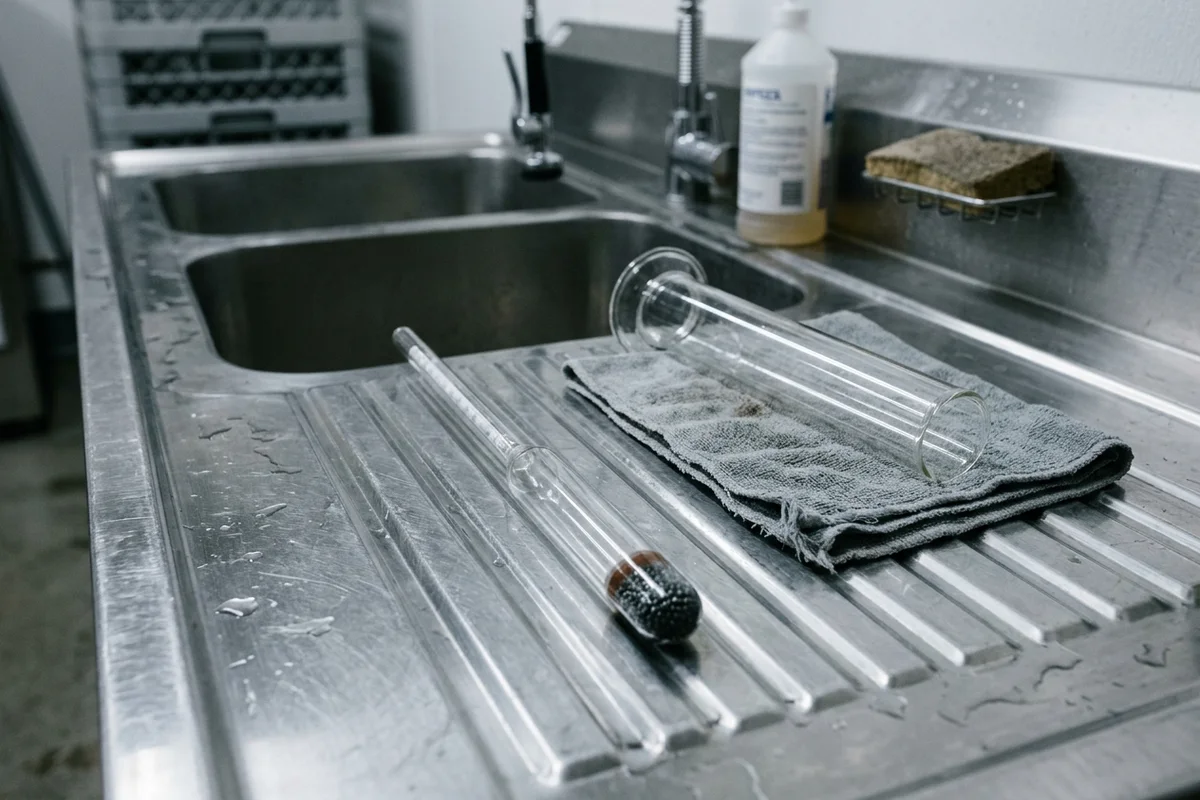
Even when a final hydrometer reading cannot tell you the alcohol percentage, it is still useful for checking whether density has stopped dropping. Before testing for alcohol, confirm that fermentation has actually finished using the four checks for a completed wine fermentation.
Which finished-wine instruments work when starting gravity was missed?
When starting gravity was never recorded, you need a method that either isolates the alcohol physically, measures a thermal or capillary property tied to ethanol, or combines two different physical measurements on the same finished sample. The table below compares the four practical routes described in AWRI’s alcohol measurement summary, WineMaker Magazine’s home wine lab guide, and Brewbitz’s testing guide.
| Method or instrument | How it measures alcohol without OG | Sample & residual-sugar condition | Reported accuracy or scope in sources | Equipment & operating notes |
|---|---|---|---|---|
| Glass capillary vinometer | Fills a thin glass tube until wine drips from the tip, then inverts it so capillary action and surface tension hold a column read against an ABV scale | Must be fully fermented (dry), perfectly clear, degassed, and have no added sugar (Brewbitz) | Rough cellar estimate only; Brewbitz recommends taking 3 readings and averaging them | Low-cost glass capillary tube; residual sugar, suspended solids or CO₂ invalidate the reading |
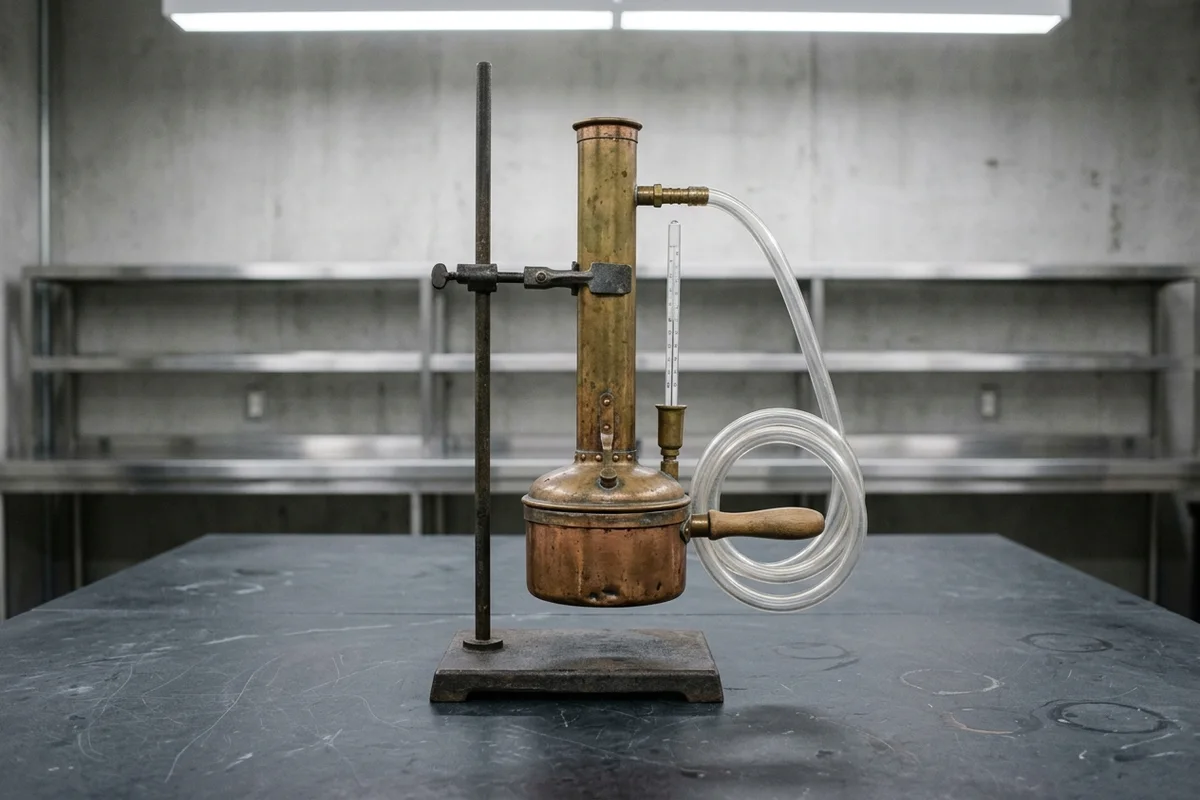
| Ebulliometer (boiling-point apparatus) | Compares the boiling point of the wine sample against pure water, using ethanol’s boiling-point depression | Wines containing about 2% (20 g/L) or less residual sugar (WineMaker Magazine); sugar interferes by raising the boiling point (AWRI, citing Zoecklein et al. 1995) |
Generally about 0.5% alcohol; AWRI states it is not recommended for label declarations |
New units cost around $1,300 per WineMaker Magazine (used units vary); requires burner, thermometer, water blank and wash-up space |
| Paired refractometer + digital density meter | Measures refractive index and liquid density on the same finished sample; software solves the two-variable relationship for sugar and alcohol | Clear, degassed wine sample; works across dry and sweet styles because both density and refraction are measured together | Calculates both sugar concentration and alcohol content in finished wine (WineMaker Magazine) | WineMaker Magazine notes consumer Bluetooth digital density + refractometer combos cost around $750 (~$500 for the density meter alone) |
| Mini-distillation + hydrometry or densitometry (or titrimetric kit) | Boils a measured wine volume to separate volatile ethanol into a distillate, then measures the distillate with an alcohol hydrometer or density meter | Applicable to dry, off-dry or sweet wines because non-volatile sugars and acids stay behind in the boiling flask | Reference principle when temperature is controlled and converted with published tables (AWRI) | WineMaker Magazine lists mini-distillation glassware at $75–$300 and titrimetric alcohol kits at around $300; requires condenser water, heat source and careful temperature correction |
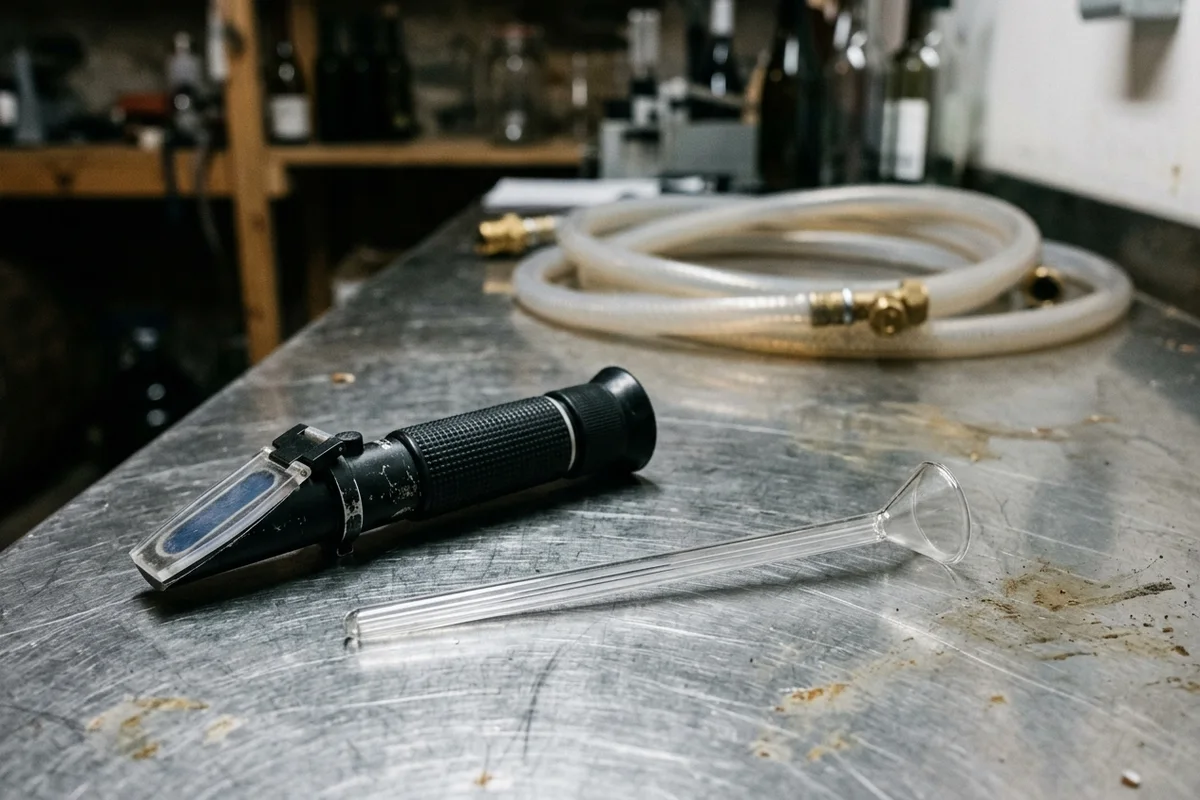
Before running any capillary, density or optical test on a finished batch, make sure the sample is free of suspended lees and excess dissolved carbon dioxide. Alison Crowe notes in WineMaker Magazine that gas bubbles cling to hydrometer stems and distort light refraction in refractometers. If your wine still holds fermentation fizz, review the pre-bottling wine degassing checks before testing a sample.
How do sugar additions, water dilution and blending change what you can estimate?
Some winemakers try to reconstruct a missing starting gravity from the recipe or from the sugar nutrition panel on store-bought juice. Whether a recipe back-calculation is meaningful depends entirely on what happened to the must between crush and bottling:
- Unadjusted juice or wine kit with a known starting volume: If you fermented preservative-free juice or a standard wine kit at its exact target volume without adding extra sugar, fruit or water, the kit manual’s target specific gravity only tells you the intended starting range—not a verified measurement of your batch.
- Chaptalization (sugar additions) or step-feeding during fermentation: Adding table sugar, honey or concentrate after fermentation starts raises the total potential alcohol without showing up in a single gravity snapshot. Unless both the exact weight of every sugar addition and the exact liquid volume at each step were logged, back-calculating an original gravity turns into guesswork.
- Back-sweetening or arrested fermentation: Once sugar is added after fermentation (or if yeast stalls early), unfermented sugar increases liquid density, raises the boiling point in an ebulliometer, and alters capillary drainage in a vinometer. Neither a vinometer nor an uncorrected ebulliometer should be trusted on sweetened wine.
- Water dilution, topping up or cross-batch blending: Topping up a carboy with water or another wine after racking changes the alcohol concentration of the batch directly. Any pre-fermentation gravity calculation no longer applies to the diluted or blended wine; only a direct measurement of the finished liquid reflects what is in the carboy.
Do not invent a starting gravity from generic grape-variety averages or try to judge alcohol percentage by warmth on the palate. Leave unknown starting values blank in your cellar book and record only what is measured on the finished wine.
When should you use a wine laboratory, and what should you request?
If you need an exact alcohol figure—whether to evaluate microbial stability in a high-risk batch, check a sweet or fortified style where home instruments fail, or meet commercial labeling rules—contract laboratory analysis is the reliable path.
In AWRI’s guide to determining laboratory scope, alcohol content works alongside residual sugar (glucose plus fructose), free and total sulfur dioxide ($\text{SO}_2$), pH and titratable acidity (TA) to indicate a wine’s spoilage risk, because ethanol inhibits many spoilage microorganisms while residual sugar feeds them. AWRI also points out that once alcoholic fermentation is complete, the alcohol content of a closed batch does not change markedly, so a single contract laboratory test settles the number for that lot.
Commercial laboratories measure finished wine without needing your starting hydrometer log by using one of four reference techniques described by AWRI:
- Distillation / densitometry: A wine sample is distilled to separate volatile ethanol from non-volatile sugars and acids, and the distillate’s density is measured in a temperature-controlled density meter (or a pycnometer weighed on a four-decimal-place analytical balance) and converted via published tables.
- Distillation / hydrometry: The distilled fraction is measured with a calibrated alcohol hydrometer, with sample temperature recorded and corrected against standard tables.
- Near-infrared (NIR) or mid-infrared (MIR) spectroscopy: The wine sample is scanned directly in a temperature-controlled cell using an instrument calibrated against primary reference methods.
- Gas chromatography (GC): Automated, high-precision separation used by larger wine laboratories equipped with carrier-gas supplies and specialist staff.
Keep personal cellar records separate from commercial labeling requirements. Under US federal rules (27 CFR 24.75, summarized in our home winemaking guide), wine made at home is strictly for personal or family use and cannot be sold. For bonded commercial producers in the United States, the Alcohol and Tobacco Tax and Trade Bureau (TTB) mandates a numerical % alcohol by volume statement on labels for wines over 14% ABV (and regulates optional numerical statements or “table wine” / “light wine” designations for wines from 7% to 14% ABV), while AWRI notes that Australian retail labels typically require alcohol accuracy within 0.5% alcohol. Ebulliometry is not recommended for label declarations; use an accredited wine laboratory when regulatory compliance applies.
Blank lab-submission checklist and next-batch gravity log
Copy the first table when deciding how to test a finished batch that lacks a starting gravity reading, and use the second template on your next fermentation so the starting benchmark is never missed. Leave any unmeasured field blank rather than filling in an assumed number.
Finished-wine assessment and laboratory request record
| Field | Your batch entry |
|---|---|
| Batch ID, grape variety / fruit source or kit name | |
| Starting gravity (OG / °Brix) status | Missing / not recorded at yeast pitch |
| Documented sugar, concentrate or water additions during fermentation | |
| Topping-up liquid or cross-batch blending after racking | |
| Final hydrometer reading (FG), sample temperature and hydrometer calibration temperature | |
| Fermentation completion check (stable multi-day FG + residual-sugar test result) | |
| Sample clarity and degassing status (clear vs. hazy; still vs. spritzy) | |
| Selected cellar instrument (if dry/applicable) or contract wine laboratory name | |
Laboratory analytes requested (Alcohol % v/v, Glucose + Fructose g/L, pH, TA, Free/Total $\text{SO}_2$) |
|
Reported alcohol content (% v/v), method used and report date |
Next-batch hydrometer and temperature log template
When you start your next batch, record the gravity after sulfiting and sugar adjustments—before pitching yeast—as outlined in Step 3 of our home winemaking guide. As Seed To Pantry School and WineMaker Magazine emphasize, always check the calibration temperature printed on your specific hydrometer (commonly 59 °F / 15 °C, 60 °F, or 68 °F / 20 °C) and degas or strain the sample in the test jar before reading at eye level.
| Stage | Date | Sample temperature | Hydrometer calibration temp | Raw reading (SG or °Brix) | Temp-corrected reading | Additions or volume changes logged |
|---|---|---|---|---|---|---|
| 1. Initial must (before sugar adjustment) | ||||||
| 2. Adjusted must (OG before pitching yeast) | ||||||
| 3. Transfer to secondary carboy | ||||||
| 4. End-of-fermentation check (Day 1) | ||||||
| 5. End-of-fermentation check (Day 3+ stable FG) | ||||||
| 6. Pre-bottling check (before bottling the wine) |
Frequently asked questions
Can you float a spirit alcoholmeter in finished wine to read the ABV?
No. Essential Distilling notes that spirit hydrometers and brewing or wine hydrometers use different calibrations and are not interchangeable. The Australian Wine Research Institute (AWRI) explains that alcohol hydrometry in wine analysis is performed on the distilled ethanol-water fraction after distillation removes sugars, acids and other non-volatile solids.
What does the Potential Alcohol scale on a wine hydrometer show after fermentation?
Nothing about the alcohol already in the wine. As Seed To Pantry School and Essential Distilling explain, the Potential Alcohol scale estimates how much alcohol unfermented sugar could produce before yeast is pitched. In finished wine, you still need both the starting reading and the final reading to calculate alcohol by volume.
Does a vinometer work on sweet or sparkling wine?
No. Brewbitz states that a glass capillary vinometer gives only an estimate based on the average of three readings, and it will not give an accurate reading if the wine has not fully fermented, is not clear, or has had sugar added.
Methodology and sources
This guide was compiled on October 17, 2026 from technical publications by the Australian Wine Research Institute (AWRI), WineMaker Magazine (articles by Dawson, July 2025, and Alison Crowe, updated December 2025), the US Alcohol and Tobacco Tax and Trade Bureau (TTB), Essential Distilling, Brewbitz, and Seed To Pantry School. The decision tables and logs are editorial planning tools synthesized from those public sources; no wine samples were tested or distilled for this article, and all batch record fields are intentionally left blank for the winemaker or laboratory to complete.